2.5.2 Mannich Reaction
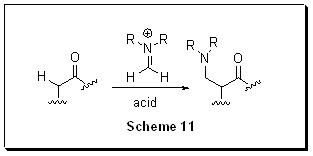
Compounds that are enolic react with a mixture of an aldehydes and a primary or secondary amine in the presence of acid (Scheme 11).
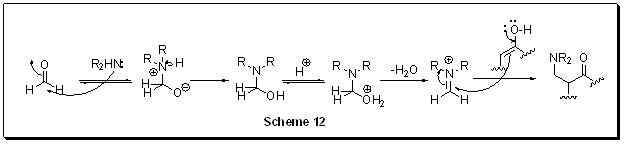
Amines react with aldehydes in the presence of acid to give an adduct that eliminates water to form an electrophiles, and the acid also catalyzes the conversion of ketone into its enol tautomer. The enol then reacts with the electrophiles and the resulting adduct tautomerizes to the amine salt (Scheme 12).
Mechanism
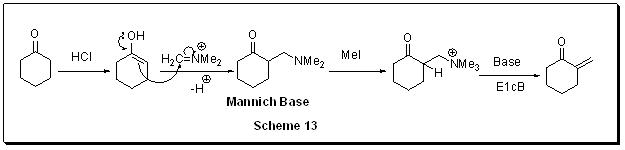
 Mannich reaction is one of important reactions in organic synthesis. It provides a simple route for the preparation of amino-ketones and many drug molecules belong to this class. Furthermore, the Mannich products can be converted into enones. For examples, the most reliable method for making enone is to alkylate the Mannich base with MeI and then treat with base (Scheme 13).
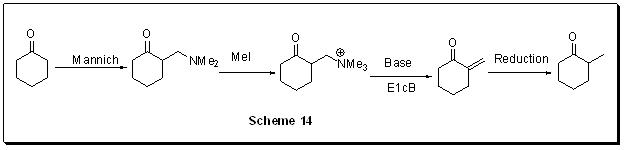
Although the reaction is similar to the Hofmann elimination of a quarternary ammonium salt, Mannich base--hydrochlorides undergo elimination readily because the double-bond which is generated is conjugated with unsaturated group. Eliminations of this type have advantages. For example, the reduction of C=C bond gives the next highest homologue of the ketone from which the Mannich base was derived (Scheme 14).