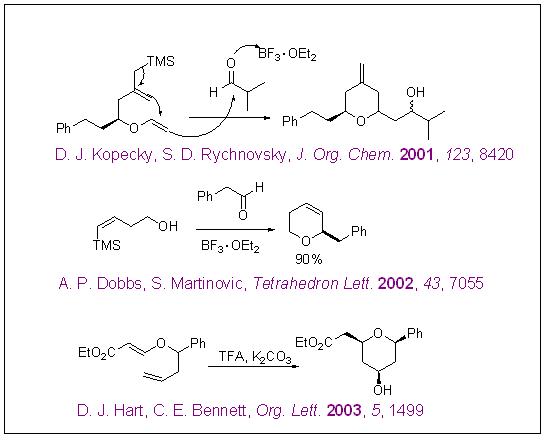
2.5.1 Prins Reaction
2.5.1.1 The Original Prins Reaction
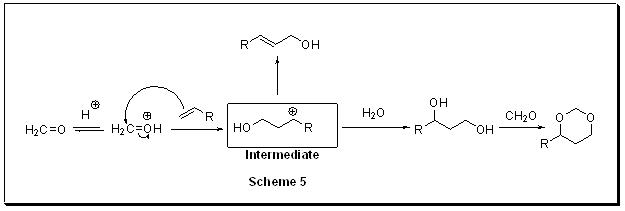
Prins reaction has remarkable scope which sometimes affords useful molecules that are difficult to prepare by other methods. The reaction involves an electrophilic addition (Markovnikov) of aldehyde or ketone to an alkene in presence of an acid followed by capture of a nucleophile. The outcome of the reaction depends on nature of the substrates and reaction conditions. For examples, with water and protic acid, the reaction product is a 1,3-diol. In absence of water, dehydration takes place to give an allyl-alcohol. With an excess of HCHO, the reaction product is dioxane. When water is replaced by acetic acid, corresponding esters are formed (Scheme 1).
2.5.1.2 The Formation of Tetrahydropyrans
Aliphatic alkenes undergo Prins reaction. For example, the reaction of propene, HCHO and HCl gives 4-chloro-tetrahydropyran in good yield (Scheme 6).

Diastereoselective version of this reaction has also been considerably explored. For example , the synthesis of highly substituted 4-hydroxytetrahydropyran can be accomplished using rhenium(VII) complex, O3 ReOSiPh3 , as a catalyst under milder conditions (Scheme 7).

Examples: