2.5.1.3 The Carbonyl-Ene Mechanism
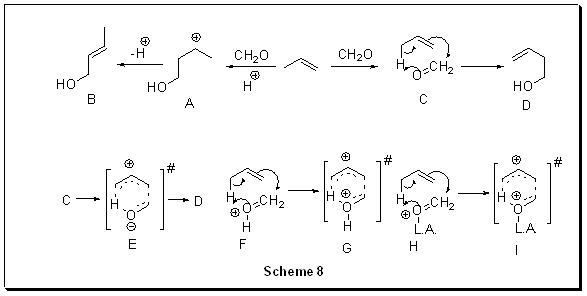
Let us analyze the mechanism described in Scheme 6 again. The formation of terminal alkene D takes place compared to the more stable internal alkene B. These results suggest that the mechanism is similar to that of a carbonyl ene reaction having the hydrogen transfer and addition of HCHO concerted C (B. J. Snider, Comp. Org. Syn. Vol. 2, p. 527). The intermediate C is polar having partial charges E that could be stabilized and the reaction accelerated by protic acids G and Lewis acids I (Scheme 8).
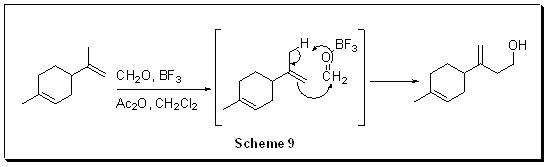
Lewis acids are found to be excellent catalysts and the reaction can be stopped after the first step. This is advancement in the Prins reaction because otherwise a mixture of products is generally obtained. For example, the addition of HCHO to limonene using BF3 selectively affords a single compound in good yield with excellent chemo- and regioselectivity (Scheme 9).
2.5.1.4 Stereoselectivity
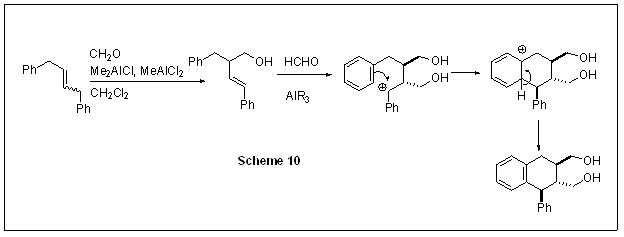
The stereochemistry of the product can be controlled. For example, a mixture of E and Z 1,4-diphenylbut-2-enes with formaldehyde in presence of a mixture of MeAlCl2 and Me2 AlCl gives cyclized product with anti-selectivity in 50% yield. Irrespective of the geometry of the starting alkene a single anti product is obtained. This reaction involves a carbonyl ene reaction followed by Friedel-Crafts alkylation (Scheme 10).