11.9 Nickel Catalysts
Nickel-based catalytic systems are used in the production of many industrial and consumer products, and play a key role in organic synthesis.
11.9.1 Hydrogenation
Raney Ni (Ni-Al) is produced when a block of Ni-Al alloy is treated with concentrated NaOH. This treatment, called "activation", dissolves most of the Al out of the alloy. The porous structure left behind has a large surface area, which gives high catalytic activity. The ratio of Ni to Al is around 1 for the original material used by Raney, and may vary from about 1 to 4.
| Ref : T. K. Yang, D. S. Lee, Encyclopedia of Reagents for Organic Synthesis , John Wiley and Sons, Inc., L. A. Paquette, Ed., New York, 1995, 6 , 4401. |
It is one of the common catalysts used for the hydrogenation of aromatic compounds. A practical example is shown in Scheme 1, where benzene is reduced to cyclohexane.
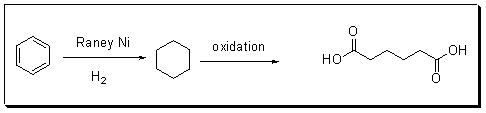
Scheme 1
Raney Ni is also used for the reduction of a series of functional groups. For example, Raney Ni is particularly useful for the cleavage of C-S bond (Scheme 2).
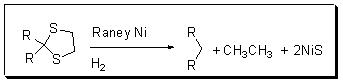
Scheme 2
The Raney Ni modified by tartaric acid and NaBr is an excellent catalyst for asymmetric hydrogenation of β -keto esters, β -ketones and β -keto sulfones (Scheme 3). Appropriate pH, temperature and concentration of NaBr should be carefully chosen.
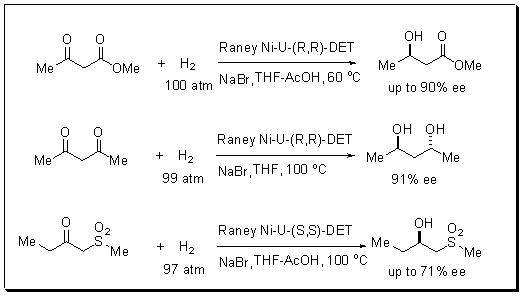
Scheme 3