1.5.1 Reactions Involving Alkynes
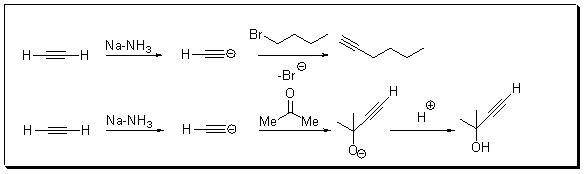
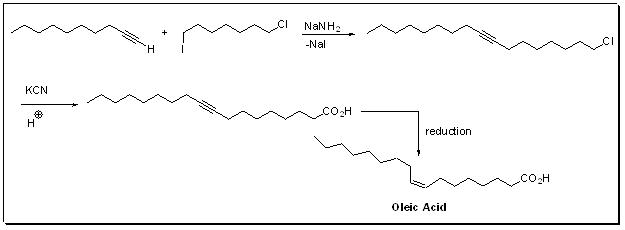
Acetylene and its monosubstituted derivatives are more acidic than alkenes and alkanes and take part in reactions with both carbonyl-containing compounds and alkyl halides in the presence of base (Scheme 12).
Application
Scheme 12
1.5.2 Reactions of Cyanides with Alkyl Halides and Sulfonates
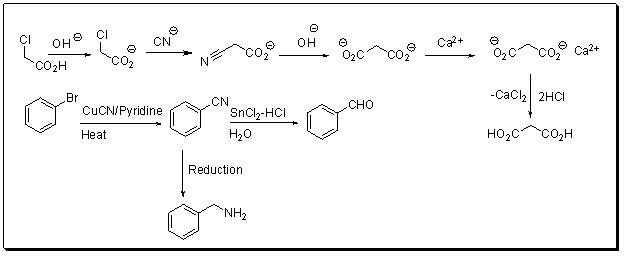
HCN, like acetylene, is a weak acid whose anion may be generated by base and is reactive towards primary and secondary alkyl halides and sulfonates to give the corresponding nitriles. It is more convenient to introduce the cyanide as cyanide ion (e.g. NaCN, TMSCN) rather than as HCN. These reactions provide a way of extending aliphatic carbon chains by one carbon atom. Scheme 13 summarizes some of the useful transformations.
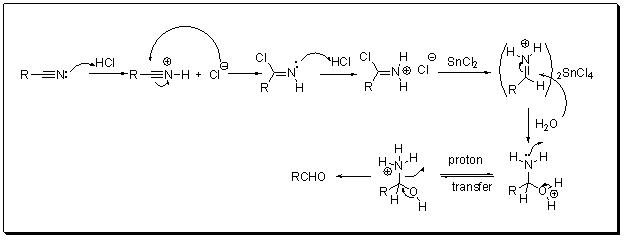
Mechanism for Stephen Aldehyde Synthesis (Stephen Reduction)
Scheme 13