1.2.2.3 Enamines
The reaction of secondary amine with aldehyde or ketone that contains an a -hydrogen atom affords enamine (Scheme 4). The process is driven to right by removing the water as it is formed, either by azotropic distillation or with molecular sieves.
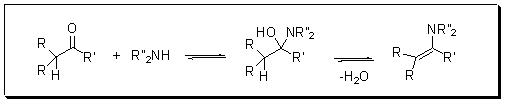
Scheme 4
Similar to the enolates derived from ketones, enamines react with acid chlorides to give imine derivative that could be hydrolyzed to β -diketones (Scheme 5).
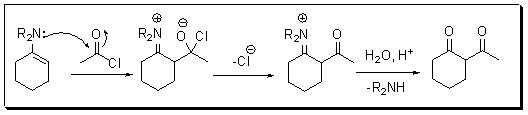
Scheme 5
In case of unsymmetrical ketones, less substituted enanime forms as a major product (Scheme 6).
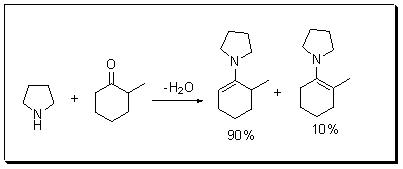
Scheme 6
1.3 The Alkylation of Enolates
Enolates, like other nucleophiles, also undergo reaction with alkyl halides and sulfonates with the formation of carbon-carbon bonds. Depending on the reaction conditions and nature of the substrates, the reaction can occur either at oxygen atom or carbon atom of enolate (Scheme 7).
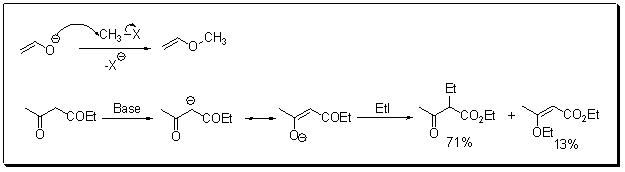
Scheme 7
1.3.1 Alkylation of Monofunctional Compounds
Depends on the reaction conditions (kinetic vs thermodynamic control), enolate can be selectively alkylated (Scheme 8).
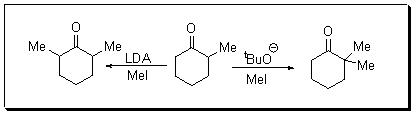
Scheme 8