In aq phase, two hydroperoxyl radicals can combine if their concentrations allow them to react significantly yielding H2O2 and O2 (disproportionation reaction).
In turn, H2O2 can scavenge an electron from the conduction band or from the superoxide, and accordingly be reduced to a hydroxyl radical OH. and a hydroxide ion OH‑.
Because these reactions are known to take place in homogeneous aqueous phases, they are believed to occur at the photocatalyst surface as well. In other words, the very oxidizing hydroxyl radical might be produced, in principle, by the three-electron reduction of O2:
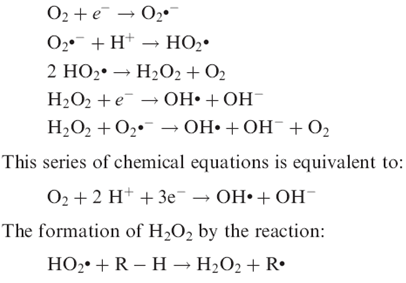
To summarize, the chemistry occurring at the surface of a photoexcited semiconductor is based on the radicals formed from O2, H2O, and electron-rich organic compounds.
Also note that cations in aqueous solution can be directly reduced by conduction band electrons provided that the redox potentials of these cations are adequate (i.e., lying below the conduction band energy)
Because the active species that can affect chemical transformations are those created at the photocatalyst surface or those reaching it, the photocatalytic reaction occurs, at least principally, in the adsorbed phase, and the overall process can be formally divided into five steps:
1. Transfer of the reactants from the fluid phase to the surface;
2. Adsorption of at least one of the reactants;
3. Reaction in the adsorbed phase;
4. Desorption of the product(s); and
5. Removal of the product(s) from the interfacial region.
As the adsorption and desorption rates are temperature-dependent, temperature can have an effect on the photocatalytic reaction rates. Increased rates on raising the temperature above the ambient temperature have been observed.