Photocatalytic Degradation of Pollutants
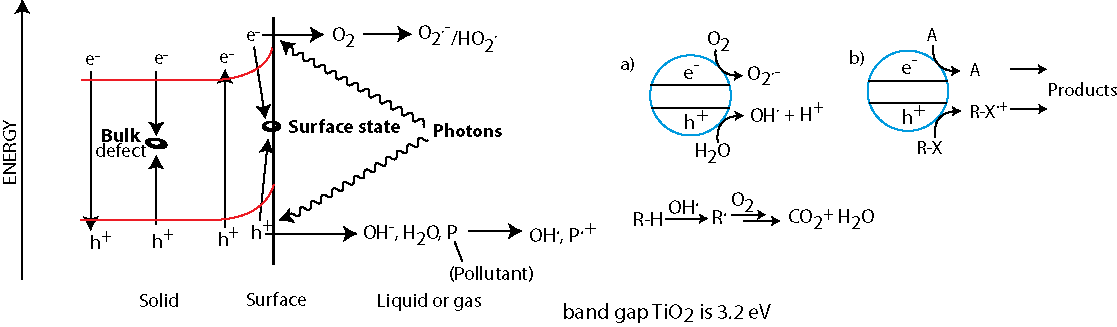
band gap TiO2 is 3.2 eV
- The absorption of exciting photons, most often in the ultraviolet spectral range, by a semiconductor promotes electrons from the filled valence band to the vacant conduction band.
- The electron–hole pairs can recombine either directly (band-to-band recombination) or, most often, indirectly (e.g., via bulk or surface defects) by radiative and nonradiative processes.
- If the charges are localized by trapping at surface states, their mean lifetime can be long enough to allow their transfer to adsorbed electron donors or acceptors. Provided that the resulting intermediates are transformed before back electron transfer occurs, a photocatalytic redox reaction is produced.
- In the presence of dioxygen, adsorbed oxygen species are the most probable electron acceptors. Undissociated oxygen leads to the superoxide radical ion, or its protonated form, the hydroperoxyl radical HO2.