Module 1 : Atmospheric Composition and Principles of Contaminant Behavior

Lecture 3 : The Greenhouse Effect on Earth


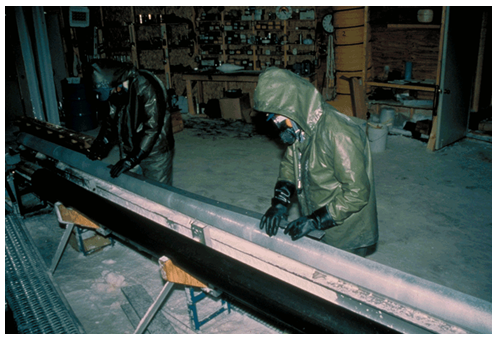
Antarctic Ice Core

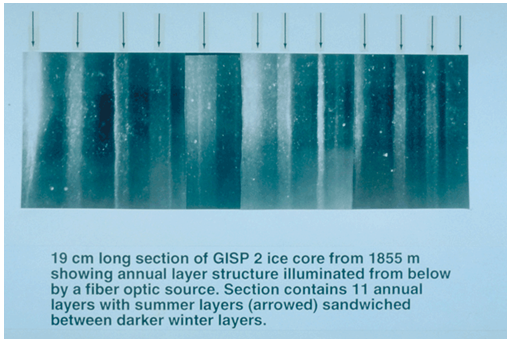
Located high in mountains and in polar ice caps, ice has accumulated from snowfall over many millenia . Scientists drill through the deep ice to collect ice cores. These cores contains dust, air bubbles, or isotopes of oxygen, that can be used to interpret the past climate of that area.

From NOAA Paleoclimatology Website.

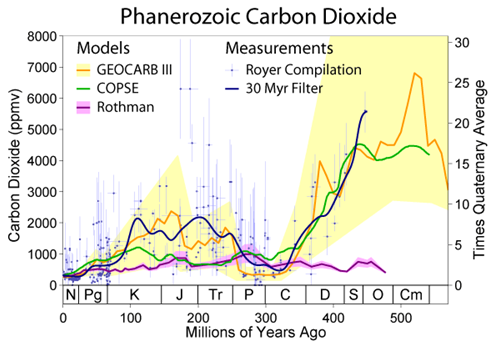
  • This figures shows estimates of the changes in carbon dioxide concentrations during the Phanerozoic . Three estimates are based on geochemical modeling: GEOCARB III (Berner and Kothavala 2001), COPSE (Bergmann et al. 2004) and Rothman (2001). These are compared to the carbon dioxide measurement database of Royer et al. (2004) and a 30 Myr filtered average of those data. Error envelopes are shown when they were available. The right hand scale shows the ratio of these measurements to the estimated average for the last several million years (the Quaternary). Customary labels for the periods of geologic time appear at the bottom.

  • Direct determination of past carbon dioxide levels relies primarily on the interpretation of carbon isotopic ratios in fossilized soils (paleosols) or the shells of phytoplankton and through interpretation of stomatal density in fossil plants. Each of these is subject to substantial systematic uncertainty.

  • Estimates of carbon dioxide changes through geochemical modeling instead rely on quantifying the geological sources and sinks for carbon dioxide over long time scales particularly: volcanic inputs, erosion and carbonate deposition. As such, these models are largely independent of direct measurements of carbon dioxide.

  • Both measurements and models show considerable uncertainty and variation; however, all points to carbon dioxide levels in the past that have been significantly higher than they are at present.


CO2 over 500 million years