CO2
CO2 is a colorless gas…
- condenses into solid form (dry ice) at -78°C in atmospheric pressure.
- condenses into liquid at -57°C at pressure above 5.1 atmospheric pressure.
Atmospheric CO2 is derived from (The sources …)
- Volcanic outgassing
- burning of organic matter
- Respiration of living organisms
- …
CO2 can be stored in (The Sinks …)
- Highly soluble in water: forms H2CO3
- Dissolved CO2 in water can interact with silicate minerals to form carbonated minerals…
- …
Carbon Dioxide Cycle
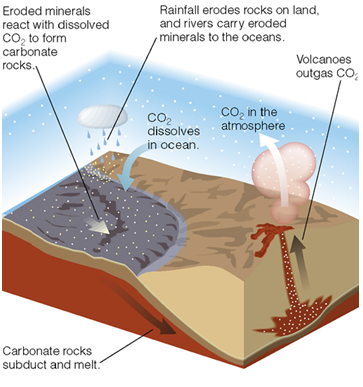
The mechanism by which Earth self-regulates its temperature is called the carbon dioxide cycle , or the CO2 cycle for short.
Starting with the carbon dioxide in the atmosphere:
- Volcanoes outgas CO2 into the atmosphere.
- Atmospheric carbon dioxide dissolves in the oceans.
- At the same time, rainfall erodes rocks on Earth's continents and rivers carry the eroded minerals to the oceans.
- In the oceans, the eroded minerals combine with dissolved carbon dioxide and fall to the ocean floor, making carbonate rocks such as limestone.
- Over millions of years, the conveyor belt of plate tectonics carries the carbonate rocks to subduction zones, and subduction carries them down into the mantle.
- As they are pushed deeper into the mantle, some of the subducted carbonate rock melts and releases its carbon dioxide, which then outgasses back into the atmosphere through volcanoes.
The CO2 Cycle
The CO2 cycle acts as a thermostat that regulates the temperature of the Earth…
If Earth warms up a bit, then
If Earth cools a bit,
|
 |