Earth's Temperature Variation in the past 1,100 years
Surface Temperatures over the last 1,100 Years
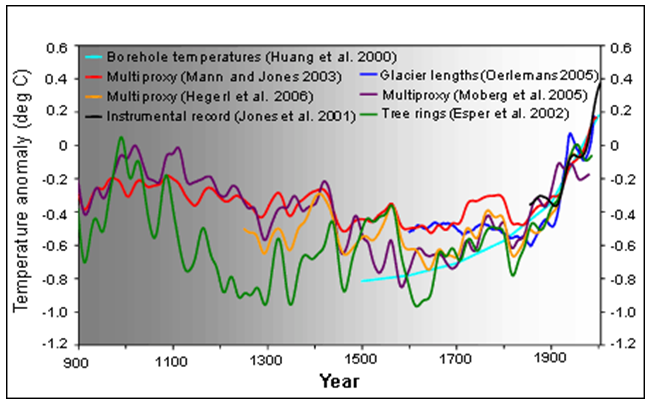
Reconstructions of (Northern Hemisphere average or global average) surface temperature variations from six research teams (in different color shades) along with the instrumental record of global average surface temperature (in black). Each curve illustrates a somewhat different history of temperature changes, with a range of uncertainties that tend to increase backward in time (as indicated by the shading). Reference: NRC, 2006. (Figure reprinted with permission from Surface Temperature Reconstructions© (2006) by the National Academy of Sciences, Courtesy of the National Academies Press 22 18, Washington, D.C.).
Reproduced from EPA Climate Change Website.
The Long-Term Stability of Earth's Climate − 400,000 years
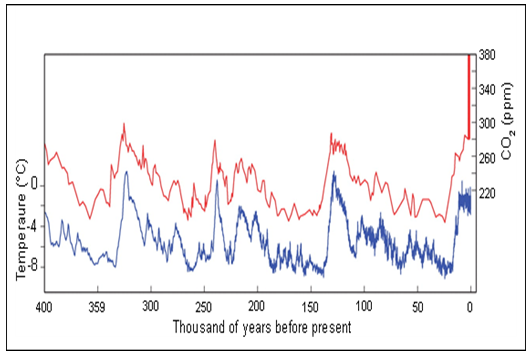
How do we measure atmospheric CO2 concentration in the past?
- Precise measurements of atmospheric CO2 concentration is available only in the last few decades…
- Information about atmospheric CO2 concentration and temperatures in the past can be inferred by several different methods, such as
– Tree-ring
– Deep ocean sediment
– Ice core records – Coral
– … s
Link to NOAA Paleoclimatology Website
Paleoclimatology is the study of climate prior to the widespread availability of records of temperature, precipitation and other instrumental data.