3.10.2. Types of Drug Targets
The completion of the human genome project has set the stage to the biomedical researchers to revolutionize the medical advancement for disease care. In 1997, 100,000 protein-coding sequences were hypothesized to exist in the human genome. Many of these were supposed to hold the keys to treat disease. However, the number of molecular targets 'hit' by all marketed drug substances were estimated by Drews and Ryser as about 482. About 8,000 targets of pharmacological interest were estimated in 2002, after the sequencing of the human genome. Out of that nearly 5,000 target were found as potentially hit by traditional drug substances, about 2,400 by antibodies and about 800 by protein pharmaceuticals. On the basis of ligand-binding studies, 399 molecular targets were identified belonging to 130 protein families, and 3,000 targets for small-molecule drugs in the human genome.
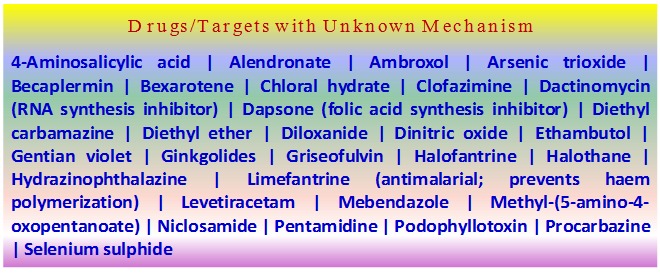
Despite the existence of enormous number of drug targets, drug discovery generally focuses on following first seven major categories of drug targets. However, there are some drug in present market which shows various physicochemical mechanisms of action on target and some drugs with biological response but their target or the mechanism of action is yet to be invented fully.
- Enzymes (Table 1)
- Substrates, metabolites and proteins
- Receptors/Nuclear Hormone Receptors
- Ion channels
- Transport proteins
- DNA/RNA and the ribosome
- Targets of monoclonal antibodies
- Targets of Various physicochemical mechanisms
- Unknown Targets of some drugs
Some approaches of drug action attempt to inhibit the functioning of the pathway in the diseased state by causing a key molecule/bio-molecule to stop functioning. Thus, drugs may be so design as bind to the active region and inhibit this key molecule. Another approach of drug action enhances the normal pathway by promoting specific molecules in the normal pathways that may have been affected in the diseased state. In addition, these drugs should also be designed in such a way as not to affect any other important off-target molecules or anti-targets that may be similar in appearance to the target molecule. Because, drug interactions with off-target molecules may leads to undesirable side effects causing risk.
Thus, it is clear that in drug discovery, target classes influence everything from automation engineering to the design of chemical libraries. Here, we will discuss about one target class, enzymes, and provide an assessment of what kinds of enzyme inhibitors are potent drug candidate.