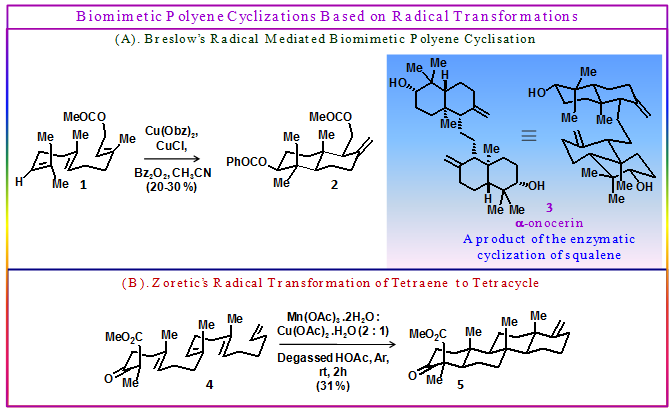
Figure 3.55: Biomimetic polyene cyclizations based on radical transformations-Contribution by (A) Breslow and by (B) Zoretic.
Snider developed manganese(III)-based oxidative free-radical cyclizations in the presence of copper(II) in 1990. Snider’s work led to the formation of a wide variety of fused ring systems. Later on, in 1991, Zoretic was able to transform tetraene 4 to tetracycle 5 in 31% yield using the Mn(III)/Cu(II) combination (Figure 3.55B) wherein seven stereogenic centers are formed in an apparent diastereoselective reaction.
This above homolytic polycyclization is not limited to radical cation intermediates. This was proved by Pattenden by generating an acyl radical from an acyl selenide and Bu3SnH−AIBN which ultimately led to a tetracyclisation to occur (Figure 3.56A). This transformation creates six new stereogenic centers with a high level of diastereoselection.
This strategy was more recently elaborated by Demuth to a short biomimetic synthesis of a steroidal skeleton. (−)-Menthone was used by Demuth as a remote chiral auxiliary on a terminus of the polyalkene (8). Photoinduced electron transfer then initiated the polycyclization by formation of radical cation 10. From the resulting cascade, eight stereogenic centers were created to form only two of the greater than 200 possible isomers (Figure 3.56B). The resulting ketal 9 is formed in 10% yield as a 7:1
diastereomeric ratio. Separation of the diastereomers and removal of the chiral auxiliary afforded ester 11, in >99% ee. This example is a remarkable demonstration of Remote Asymmetric Induction. Most importantly, the C3-hydroxy results from water in this approach and hence it provides a possible alternative biosynthetic pathway to produce steroids from epoxysqualene under non-oxidative conditions.
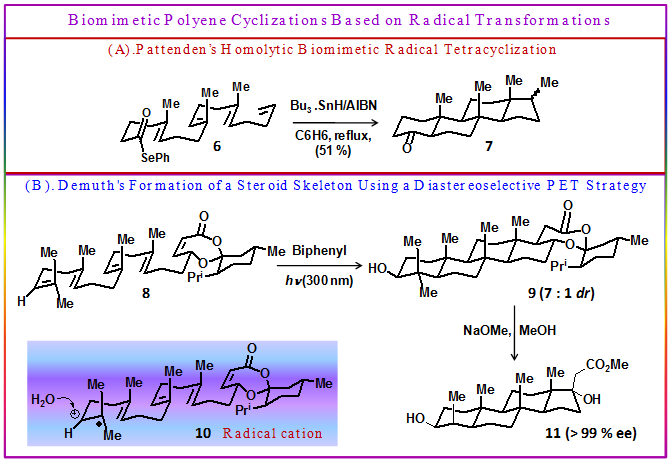
Figure 3.56: Biomimetic polyene cyclizations based on radical transformations-Contribution by (A) Pattenden and by (B) Demuth.
3.13.2.6. Summary and Outlook of Biomimetic Polyene Synthesis
From the above examples and many others it is clear that a lot of efforts have been put forth for the biosynthesis of natural terpenoides utilizing biomimetic polyene carbocyclization. It is also noticeable that in all cases, biosynthesis inspired a key polycyclization that generated substantial complexity in a single transformation. Similarly, from the synthetic studies of the polycyclization enables to discover how to stabilize developing charge at specific carbons in the squalene backbone during cyclization. This same discovery was unfolded much later during mutagenesis studies of cyclase. Therefore, the organic synthesis and biosynthetic studies are evolved concomitantly.
It was thought and considered that selectivity in catalysis is directly related with the complexity of enzyme catalyst (the protein environment) that selectivity may not be attainable with a simple small molecule catalyst. As for example, squalene−hopene cyclase enzyme uses a set of primary and secondary residues to orient and to activate squalene for cyclization. However, discovery of simple small Lewis acid catalyst, LBA by Yamamoto catalysts clearly shows that without functional/conformational complexity a simple catalyst can lead to polyene cyclization to furnish polycyclic products with high selectivity. Further research is needed to develop biomimetic catalyst wherein both selectivity and efficiency can be controlled simultaneously to reach the exact proficiency of a natural enzyme catalyst. Similarly, biomimetic total synthesis will be benefited from biosynthetic thinking and studies. Thus, both are synergistic in their future flourishment.
The value of mimicking biology should be evaluated in a case-by-case manner, yet many successes are achieved in biomimetic total syntheses. In this regard van Tamelen rightly stated: “It seems hardly necessary to add that the success of a ‘biogenetic-type' synthesis by itself does not constitute evidence for the operation of a particular chemical step in nature (although in a remarkable case, the temptation to draw such a conclusion will be great)”.