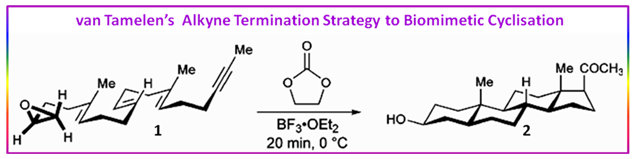
The conversion of 2,3-oxidosqualene to lanosterol is a archetypal cascade reaction in that an epoxide with one stereogenic centre is transformed to a tetracyclic steroid containing seven stereogenic centres. The efficient pioneering synthetic works of van Tamelen and Johnson demonstrated that nonenzymatic, biomimetic total syntheses based on polycarbocyclizations can be achieved easily. In 1961, van Tamelen used the term biomimetic, or biogenetic-type, as “an organic synthesis designed to follow, in at least its major aspects, biosynthetic pathways proved, or presumed, to be used in the natural construction of the end product.” Early work in the epoxysqualene biomimetic carbocyclization proved difficult due to the necessary formation of a six-membered C-ring closure over a favoured 5-exo Markovnikov addition. However, in 1982, van Tamelen utilized an alkyne as the terminating group in his cascade cyclization (1), which allowed for formation of both the six-membered C-ring and the desired five-membered D-ring (2) (below example).
3.13.2.5.3. Application of Yamamoto’s Chiral LBAs in the Enantioselective Polyenes Cyclization
Yamamoto developed the first enantioselective biomimetic cyclization of a polyprenoid using a Lewis acid-assisted chiral Brønsted acid, LBA in 1999 (Figure 3.52) as an artificial cyclase and used it to synthesize (−)-ambrox (4). Ambrox is used as a commericial substitute for ambergris and is found in such fragrances as Givenchy's Extravagance d'Amarige, due to its unique olfactory and fixative properties. The cyclization of homofarnesol (3) promoted by LBA 1 proceeded with 42% ee (Figure 3.53). This enantioselective cyclization was further improved in 2002 using LBA 2 as the promoter. The ether (−)-4 was obtained in 54% yield with 75% ee and 76% dr from 5 utilizing an enantioselective cyclization, silylation, and diastereoselective cyclization sequence (Figure 3.53). Thus, the best results were achieved by use of an achiral Lewis acid in the subsequent silyl ether cyclization.
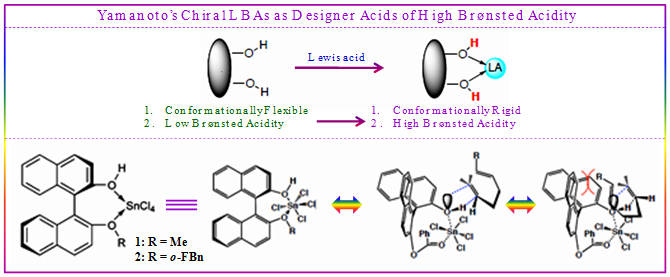
Figure 3.52: Yamamoto’s concept of designing Chiral Lewis-Brønsted Acid, LBA and its structure.