.
Thus the scaling factor may be defined as

A large value of τ the coupling is weak,while a smaller value indicates strong coupling .As the value of the coupling constant reaches one time step,the algorithm reduces to a simple velocity scaling method. Based on previous work a coupling constant of 0.4 ps is deemed to be useful for a time step of 1 fs. [Leach,2001].
Noose Hover Dynamics
In both NVT and NPT ensemble the temperature needs to be maintained. Nosé dynamics (Nosé,1984a) is a method for performing constant temperature dynamics .The approach in which an extra `thermal reservoir' variable is inserted into the dynamical equations is used to control temperature.(Eq 12). This needs a timestep of 0.5 fs with the Verlet method in order to approach within 3% of the target temperature. The smaller the timestep, the closer it approaches the target temperature.
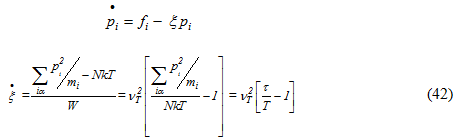
Here  is the friction coefficient which is allowed to vary in time. W is the thermal inertia parameter which is replaced by
  , a decay time for thermal fluctuations. N is the number of degrees of freedom.
 stands for instantaneous ‘mechanical temperature’. If
  > 1, then the system temperature is hot, thus the friction coefficient will increase and vice versa.
Langevin Dynamics
A molecular system in the real world is unlikely to be present in vacuum. The interaction of molecules causes friction, and the occasional high velocity collision will perturb the system. Langevin dynamics attempts to extend MD to allow for these effects. This mimics the viscous effect similar to the procedure given above .NAMD(refer NAMD user guide at: http://www.ks.uiuc.edu/Research/namd/2.9/ug.pdf) is capable of performing Langevin dynamics [Tamar, 2002] or temperature control, where damping and random forces are introduced to the system. The use of the keyword langevin, along with the desired temperature (langevinTemp) and the damping coefficient (langevinDamping) ps-1 is required for controlling the temperature.