Thus for the counter flow exchanger, the above two set equations show that the maximum possible heat exchanger is determined in terms of the inlet parameters. The maximum possible heat exchange may be determined (eq.8.6) by the fluid stream having low heat capacity rate;
|
(8.6) |

The subscript ccf denotes counter current flow. The  is for the fluid having lower value of
In case of parallel flow, regardless of the relative sizes of the two stream the limiting heat transfer condition is determine by the fact that the two fluid streams approach the same outlet temperature. Thus,
Tho → Tco condition can be found out by the weighted average of the inlet stream.

Thus, the maximum possible heat transfer may be,
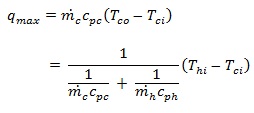
or,
|
(8.7) |
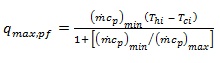
The subscript pf represents parallel flow (co-current). From the above discussion and qmax equations (8.6 and 8.7) it can be calculated for a given inlet conditions the counter current flow arrangement always has a better potential for heat transfer as compared to parallel flow arrangement.