8.2.2 Fouling factor or dirt factor
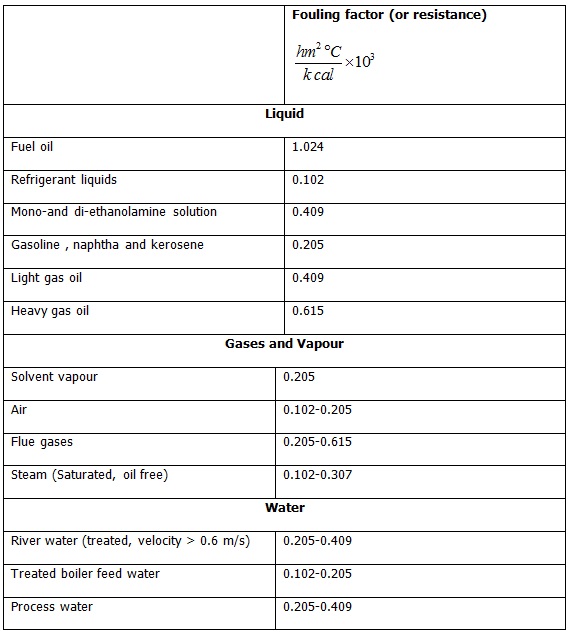
Over a time period of heat exchanger operation the surface of the heat exchanger may be coated by the various deposits present in the flow system. Moreover, the surfaces may become corroded or eroded over the time. Therefore, the thickness of the surface may get changed due to these deposits. These deposits are known as scale. These scales provide another resistance and usually decrease the performance of the heat exchangers. The overall effect is usually represented by dirt factor or fouling factor, or fouling resistance, Rf (Table 8.1) which must have included all the resistances along with the resistances due to scales for the calculation of overall heat transfer coefficient.
The fouling factor must be determined experimentally using eq. 8.4,
|
(8.4) |
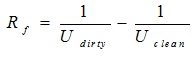
Thus to determine the Rf, it is very important to know Uclean for the new heat exchanger. The Uclean must be kept securely to obtain the Rf, at any time of the exchanger’s life.
Table-8.1 Fouling factor of a few of the industrial fluids
8.2.3 Temperature profiles in heat exchangers
Fig. 8.9 shows the temperature profile along the length of a 1-2 exchangers and 2-4 exchangers.
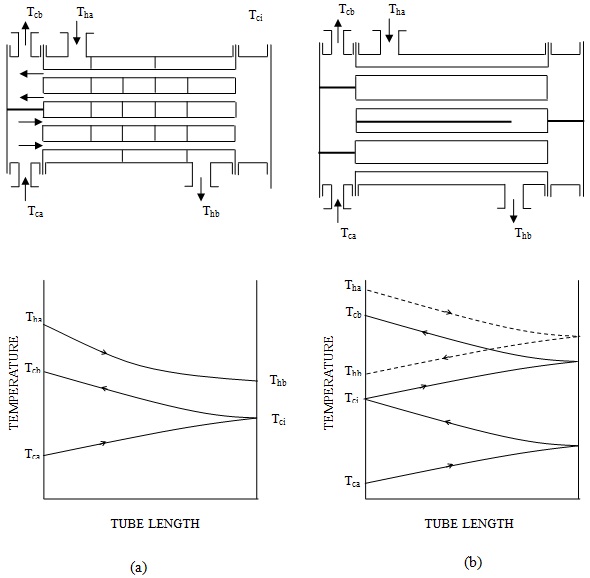
Fig.8.9 Temperature-length curve corresponding to (a) 1-2 exchanger ; (b) 2-4 exchanger