Figure 8.2 shows some baffles. These baffles (or shell-side baffles) are a metal plate usually in the form of the segment of a circular disc having holes to accommodate tubes. Shell-side baffles have two functions. The first is to create turbulence in the shell side fluid by changing the flow pattern parallel or cross flow to the tube bundles and thus increases the shell side heat transfer coefficient. The second major function of these baffles is to support the tube all along its length otherwise the tube may bend. Moreover, these baffles may have horizontal or vertical cuts (segmental baffle) as shown in fig.8.7.
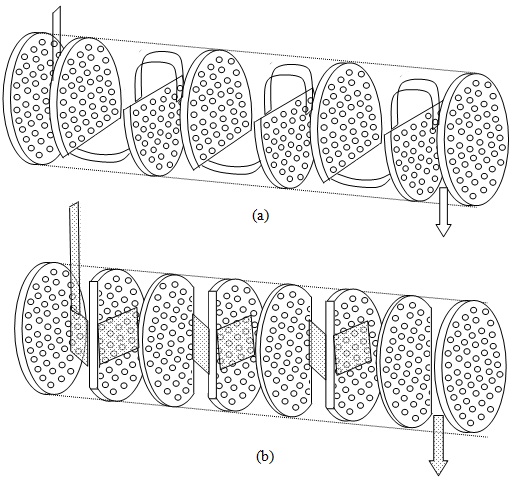
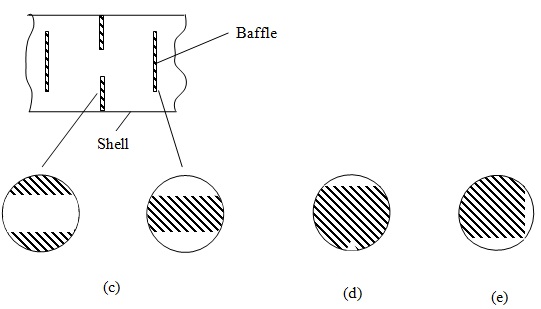
Fig.8.7: Baffles; (a) horizontal cut baffles; (b) Vertical cut baffles; (c, d and e)the shaded region show the baffle area
The cut portion of the baffle, which is called baffle window, provides the area for flow of the shell fluid. The baffle window area ranges from 15% to 50%. At 25% cut segmental baffle means that the area of the cut-out portion is 25% of the area of the baffle. The spacing between the baffles is an important aspect. A larger baffles spacing reduces the shell side pressure drop but at the same time decreases the turbulence and heat transfer coefficient. Smaller baffle spacing increases the turbulence and heat transfer coefficient. However, the pressure drop may increase significantly, thus the advantage attained due to the higher heat transfer coefficient may be nullified. Therefore baffle spacing is selected considering the allowable shell side pressure drop and the heat transfer coefficient desired. A rule of thumb is that the minimum spacing of segmental baffles is one by fifth of the shell diameter or 5 cm, whichever is larger.