In any process industry, we need to transfer heat for different operations (like cooling, heating, vaporizing, or condensing) to or from various fluid streams in various equipment like condensers, water heaters, re-boilers, air heating or cooling devices etc., where heat exchanges between the two fluids. In a chemical process industry, the heat exchanger is frequently used for such applications. A heat exchanger is a device where two fluids streams come into thermal contact in order to transfer the heat from hot fluid to cold fluid stream.
In this chapter, we will discuss about the technical analysis of the heat exchangers along with the method for predicting heat exchanger performance and operational parameters. Moreover the discussion on heat exchanger size will also be discussed. However, we will not discuss the economics (though discuss the heat exchanger size) of the heat exchanger. We will consider that the heat transfer will primarily be taken by conduction and convection only. We will describe the commonly used heat exchangers and their important characteristics.
In general heat exchangers may be categorized into two general classes depending on the relative orientation of the flow direction of the two fluid streams. If the two streams cross one another in space, usually at right angles, the heat exchangers are known as cross flow heat exchanger as shown in the fig. 8.1(a).
In the second class of heat exchanger the two streams move in parallel direction in space. The usual shell and tube heat exchanger or concentric pipe exchanger or double tube exchanger is the most frequently used exchanger in the class. Two situations may arise when the fluid flow in the parallel direction, one in which the fluids flow in same direction and the other in which the fluids flow in opposites direction. “Parallel –flow” or “Co-current flow” is used when the flow is in same direction and counter current is used when the fluid flow is in the opposite direction.
Before understanding the principle of heat exchanger we would first understand it from the point of construction.
8.1 Elements of shell and tube heat exchanger
We will discuss shell and tube heat exchanger as they or the most commonly used heat exchangers in the chemical process industries. Schematic of a typical shell and tube heat exchanger is shown in fig. 8.2.
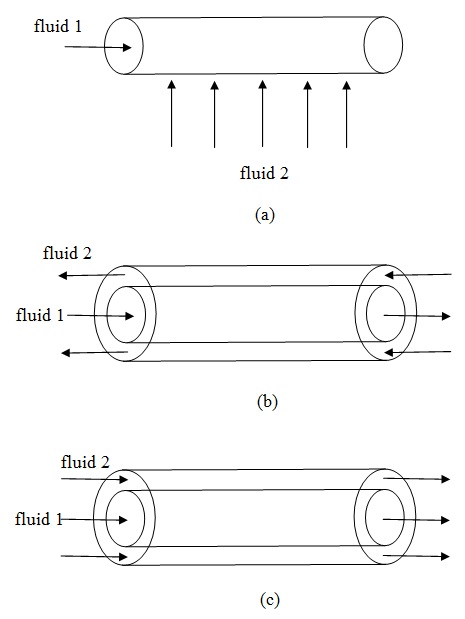
Fig. 8.1: Orientation of fluid stream in heat exchanger (a) cross flow (b) counter current flow (c) parallel flow