The product characterization is illustrated now with an example.Aviation gasoline is characterized using ASTM distillation.The specified temperatures for vol% distilled at 1 atm.Are 158oF maximum for 10 % volume, 221oF maximum for 50 % volume and 275oF maximum for 90% volume. This is indicative of the fact that any product obtained in the refinery process and meets these ASTM distillation characteristics is anticipated to represent Aviation gasoline product.However, other important properties such as viscosity, density, aniline product, sulphur density are as well measured to fit within a specified range and to conclude that the produced stream is indeed aviation gasoline.
3.4 Important characterization properties
Numerous important feed and product characterization properties in refinery engineering include
3.4.1 API gravity
API gravity
of petroleum fractions
is a measure of density of the stream. Usually measured at 60oF, the API gravity is expressed as
o API = [ 141.5/specific gravity ] – 131.5
where specific gravity is measured at 60o F.
According to the above expression, 10oAPI gravity indicates a specific gravity of 1 (equivalent to water specific gravity). In other words, higher values of API gravity indicate lower specific gravity and therefore lighter crude oils or refinery products and vice-versa. As far as crude oil is concerned, lighter API gravity value is desired as more amount of gas fraction, naphtha and gas oils can be produced from the lighter crude oil than with the heavier crude oil. Therefore, crude oil with high values of API gravity are expensive to procure due to their quality.
3.4.2 Watson characterization factor
The Watson characterization factor is usually expressed as
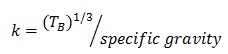
Where TB is the average boiling point in degrees R taken from five temperatures corresponding to 10, 30, 50,70 and 90 volume % vaporized.