Effect of transport processes
Effect of external transport on catalytic reaction rate
Transfer of reactants from bulk fluid to surface of catalyst particles depends on the concentration difference which is affected by the velocity pattern of fluid near the catalyst surface, physical properties of fluid and intrinsic rate of chemical reactions. While the fluid properties affect the mass transfer between fluid and catalyst surface, the intrinsic rate is determined by the condition and properties of catalyst. The external concentration profiles for reactant for solid catalytic reaction in absence and presence of mass transfer limitation is shown in Fig. 1. In absence of mass transfer there is no difference in concentration of reactant at bulk and near the catalyst surface. However, presence of significant mass transfer resistance results in a decrease in the concentration of reactants at the catalyst surface compared to that in the bulk fluid. Consequently, the observed rate is less than the intrinsic rate evaluated at bulk fluid reactant concentration.
In addition to mass transfer limitation, there may be a temperature difference between the bulk fluid and catalyst surface. The magnitude depends on the heat transfer coefficient between the fluid and catalytic surface, reaction rate constant and heat of reaction. If the reaction is endothermic, the temperature at the catalyst surface will be less than the bulk fluid temperature and the observed rate will be less than that determined at the bulk fluid temperature. If the reaction is exothermic, the temperature of catalyst surface will be more than the bulk fluid temperature. Therefore, the observed rate will be higher or lower than corresponding bulk fluid conditions, depending on both heat transfer and mass transfer effects. Rate at the surface will be higher due to heat transfer limitations and lower due to mass transfer limitations. Depending on the relative magnitude, the overall rate will be increased or decreased. Discussion in subsequent sections is limited to isothermal conditions.
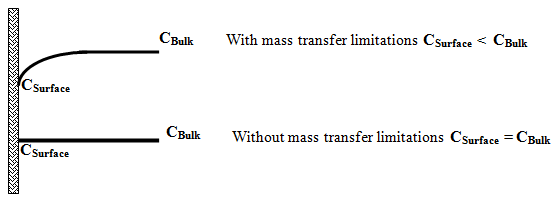
Fig. 1. External concentration profiles for reactant for solid catalytic reactions in absence and presence of mass transfer limitations