Procedure:
1. Culture of malaria parasite: malaria parsites are cultured by candle-jar method of treger and Jensen. For detail procedure, student can follow it from the http://www.mr4.org/Portals/3/Pdfs/ProtocolBook/Methods_in_malaria_research.pdf .
The screening of candidate drug molecules can be performed against malaria parasite by multiple ways: 1. 3H-Hypoxanthine uptake assay: This is a radioactive assay to monitor the growth of the parasite. Malaria parasite synthesize nucleic acid along with the growth of the parasite and DNA content of the culture is proportional to the parasite load. During the nucleic acid synthesis, parasite takes up the hypoxanthine and it gets incorporated into the parasite DNA. Hypoxanthine is radioactive and the amount of radioactive associated can be used to asses the parasite.
2. SYBR Green I based Drug Sensitivity Assay: This is a fluorescence based assay to monitor the growth of the parasite. SYBR Green I is a nuclear stain used to visualize the parasite DNA. The amount of fluorescence is proportional to the nuclear content and the parasite number in the culture.
3. Microscopic schizonticidal assay: This is the conventional light microscopy based assay to screen compounds for antimalarial activity. During the intra-erythrocytic life-cycle, malaria parasite undergoes different stages, such as ring, trophozoite and schzont (Figure 30.4). During the life-cycle, it has ring stage (0-10hrs), trophozoite (11-32hrs) and schizont (32-40hrs) and then merozoites are produced to invade new RBCs to initiate another cycle. In the microscopy based assay, ring stage parasite containing RBCs are incubated with the test compound and then the parasite growth is monitored and number of schizonts are counted after 48hrs (Figure 30.5). Hence, this assay test the effect of compounds on progression of the life-cycle of parasite and it is believed that the compounds inhibiting development of ring into the schizont stage may have potential to inhibit the growth of the parasite. With few modification, the assay can be used to test the parasitostatic and parasicidal potential of the compounds. The complete details of the assay is as follows:
A. Synchronization of malaria parasite: This is the first step where parasite culture (mixture of stages of malaria parasite) is synchronized to the ring parasite containing RBCs. It has following steps:
1. Take 4ml of a culture of >5% parasitemia.
2. Centrifuge the parasite culture at 720g for pellet down.
3. re-suspend the parasite pellet with 4ml of 5% sorbitol (in distilled water) and incubate for 10 min at room temperature. Mix and Shake it 2-3 times.
4. Centrifuge the culture at 720g and wash it 3 times with media and bring the parasite to the 5% hematocrit.
5. Repeat the step 1-4 after culturing the parasite after one cycle (approximately 48 hrs).
6. calculate the parasitemia after giemsa staining. The calculation of parasitemia is discussed later.
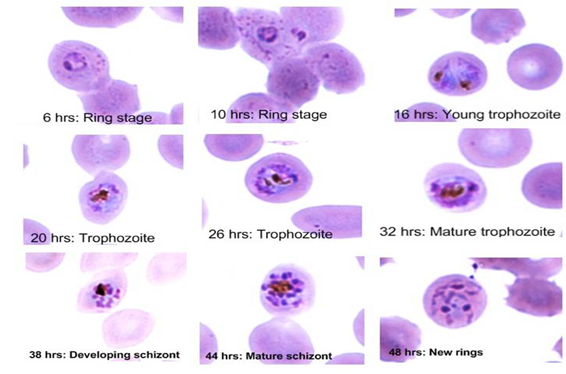
Figure 30.4: Different stages during intraerythrocytic life-cycle of malaria parasite.