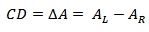
It is clear that the superposition results in a wave wherein the electric field vector traverses a circular path; this is termed as the circularly polarized light. The direction of rotation is determined by the phase difference; a –90° phase difference would result in a circularly polarized light with opposite rotation of the electric field vector. Chiral or asymmetric molecules can absorb the left and right circularly polarized lights to different extents; this differential absorption is termed as circular dichroism or CD:
 |
(9.1) |
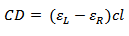
where, AL and AR are the absorbances for the left and right circularly polarized lights, respectively. Equation 9.1 can be rewritten in terms of the molar absorption coefficients of the molecule for the left and right circularly polarized lights:
 |
(9.2) |
where; εL, εR, c and l represent the molar absorption coefficient for left circularly polarized light, molar absorption for right circularly polarized light, molar concentration of the molecule, and the path length of the cell, respectively.
 |
(9.3) |
Differential absorption of the two circularly polarized lights results in elliptically polarized light and CD is historically represented in terms of ellipticity (θ) which is the angle whose tangent is the ratio of the minor to major axis of the ellipse (Figure 9.3).
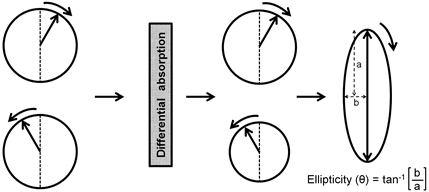
Figure 9.3: Differential absorption of left and right circular polarized light results in elliptically polarized light. Ellipticity is the arc tangent of the ratio of minor to major axis. |