Enzyme kinetics and determination of Km and Vmax
- Prepare 100 μM solution of the enzyme (200 μl ) in the Tris-HCl buffer, pH 8.0.
- Prepare 5, 10, 15, 20, 25, 50, 75, and 100 mM PNPP solutions in Tris-HCl buffer, pH 8.0.
- Record the absorbance at 410 nm using each of the PNPP solutions as follows:
- Add 2.97 ml Tris-HCl buffer in each of the 3 ml cuvettes.
- Add 30 μl of PNPP solution in both the cuvettes and mix well.
- ZERO the reading at 410 nm.
- Add 20 μl of the enzyme solution to the cuvette kept in sample cell, start the stop watch, cover the cuvette with a piece of parafilm, and quickly mix the contents by 4-5 inversions (Note 1).
- Immediately record the absorbance and then after 10 seconds interval for 2 min .
- Add 2.97 ml Tris-HCl buffer in each of the 3 ml cuvettes.
- Repeat the assay for each of the samples at least once and take the average readings for analysis.
- Plot the average absorbance value against time for each of the samples. This gives the time course of the enzymatic reaction.
- Calculate the initial velocity, V0 for each of the substrate (PNPP) concentration.
- The plot between absorbance against time is linear for the initial part of the plot and V0 is simply the slope of this line
- Fit the initial region of the curve (first 3 or 4 points) linearly and determine the slope of the line.
- The plot between absorbance against time is linear for the initial part of the plot and V0 is simply the slope of this line
- Plot V0 against substrate concentration to obtain the Michaelis-Menten curve.
- The Michaelis-Meneten equation shown in equation 12.1 can be rewritten as:
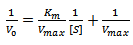
(12.2) A plot between
 and
and  gives a straight line with a slope
  and an intercept of
  on axis. This plot is known as Lineweaver-Burk plot or double-reciprocal plot and allows easy determination of the Km and Vmax of the enzyme.
 - Calculate the and for each of the substrate concentration, obtain the Lineweaver-Burk plot and calculate the Km and Vmax from the plot.
Notes:
- All the samples need to be mixed with the same number of inversions and absorbance reading recorded after same time. Mixing and the first reading should be completed within few seconds (preferably ≤ 10 seconds ).