Aim:
To determine the activity of the enzyme alkaline phosphatase
Introduction:
Enzymes play essential roles by carrying out a plethora of biological reactions. Just because a reaction has very large negative free energy change does not imply that reaction will take place at rapid rate. What it implies is that the  concentration ratio is smaller than that at equilibrium. Oxidation of glucose into CO2 and H2O, for example, is a reaction with ∆G′ of –686 kcal/mol . The glucose, therefore, is thermodynamically unstable. But we know, by experience, that a glucose solution does not break down into CO2 and H2O at a measurable rate. We can say that glucose is kinetically stable. The kinetic stability is provided by the large energy barrier between the reactant and the product (Figure 12.1)
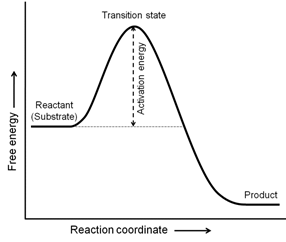
Figure 12.1: A diagrammatic representation of free energies of reactant, transition state, and the product
As is clear from figure 12.1, the reactants need excess energy, the activation energy (Ea) to cross the energy barrier between reactants and the products. The rate of the reaction is determined by the number of molecules that enter the transition state per unit time. The number of molecules populating the transition state can be increased either by increasing the temperature or by somehow decreasing the activation energy. As biological organisms survive and function within a narrow temperature window, they can't increase the rate of reaction by increasing the temperature. They manage to carry out a plethora of chemical reactions by means of enzymes that function as biological catalysts by decreasing the activation energy. The enzymes can enhance the reaction rates by up to 15 orders of magnitude. It is important to note that the enzymes do not change the equilibrium constant (Keq) or free energy change (ΔG) of the reaction. Each enzyme present in a cell has its characteristic enzyme parameters. The plot of initial reaction velocity, V0 against the substrate concentration [S] has same general shape (rectangular hyperbolic shape) which is given by Michaelis-Menten equation:
 |
(12.1) |
where, V0 is the initial reaction rate, Vmax is the maximum rate, [S] is the molar substrate concentration, and Km is a constant called Michaelis constant.