Vmax and Km are the characteristic properties of an enzyme. As is clear from equation 12.1, Km can be defined as the substrate concentration at which initial reaction rate,  .
.
The response of enzymes to the concentrations of substrates and products plays important role in the reaction control. This behavior of enzymes to the substrate/product concentration is studied under enzyme kinetics and is used to determine the important enzyme parameters such as Km and Vmax. We have chosen to study the kinetics of the enzyme alkaline phosphatase. The enzyme catalyses the hydrolysis of a phosphoester bond, producing inorganic phosphate (Pi) and an alcohol. We have chosen p-nitrophenylphosphate as the substrate for the hydrolysis reaction. Para-nitrophenylphosphate is a colourless compound; the enzyme, alkaline phosphatase hydrolyses the phosphoester bond to produce the coloured product, p-nitrophenol which can be detected colorimetrically (Figure 12.2).
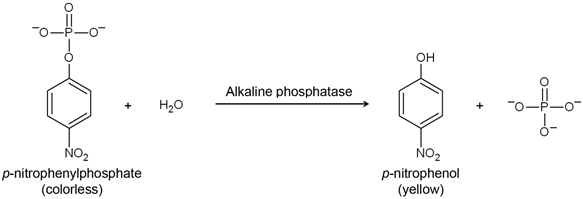
Figure 12.2: Hydrolysis of p -nitrophenylphosphate into p -nitrophenol and phosphate
Materials:
Equipments:
- UV/Visible spectrophotometer
- Weighing balance
Reagents:
- 100 mM Tris-HCl buffer, pH 8.0
- Para-nitrophenol (PNP)
- Para-nitrophenylphosphate (PNPP)
- Alkaline phosphatase from E. coli
Glassware, plasticware, etc.:
- 1.5 ml microfuge tubes
- Pipettes
- Pipette tips
- A pair of matched glass or quartz cuvettes (volume: 3 ml )
Procedure:
Standard curve of PNP
- Switch ON the spectrophotometer and allow it 30 min warm up.
- Meanwhile, prepare 0.1 mM PNP solution in 100 mM Tris-HCl buffer, pH 8.0
- Take 11 microfuge tubes and label them from 1 – 11.
- Prepare the PNP dilutions as shown in table 12.1.