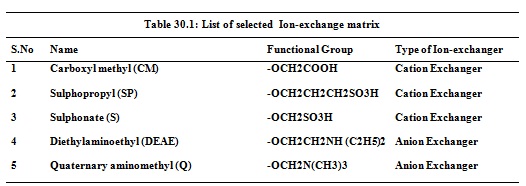
The matrix used in ion-exchange chromatography is present in the ionized form with reversibly bound ion to the matrix. The ion present on matrix participitate in the reversible exchange process with analyte. Hence, there are two types of ion-exchange chromatography:
1. Cation exchange chromatography- In cation exchange chromatography, matrix has a negatively charged functional group with a affinity towards positively charged molecules. The positively charged analyte replaces the reversible bound cation and binds to the matrix (Figure 30.2). In the presence of a strong cation (such as Na+) in the mobile phase, the matrix bound positively charged analyte is replaced with the elution of analyte. The popular cation exchangers used are given in Table 30.1.
2. Anion Exchange chromatography- In anion exchange chromatography, matrix has a positively charged functional group with a affinity towards negatively charged molecules. The negatively charged analyte replaces the reversible bound anion and binds to the matrix (Figure 30.2, B). In the presence of a strong anion (such as Cl-) in the mobile phase, the matrix bound negatively charged analyte is replaced with the elution of analyte. The popular anion exchangers used are given in Table 30.1.