Ion exchange chromatography: Ion-exchange chromatography is a versatile, high resolution chromatography techniques to purify the protein from a complex mixture. In addition, this chromatography has a high loading capacity to handle large sample volume and the chromatography operation is very simple.
Principle: This chromatography distributes the analyte molecule as per charge and their affinity towards the oppositively charged matrix. The analytes bound to the matrix are exchanged with a competitive counter ion to elute. The interaction between matrix and analyte is determined by net charge, ionic strength and pH of the buffer. For example, when a mixture of positively charged analyte (M, M+, M-1, M-2) loaded onto a positively charged matrix, the neutral or positively charged analyte will not bind to the matrix where as negatively charged analyte will bind as per their relative charge and needed higher concentration of counter ion to elute from matrix (Figure 30.1).
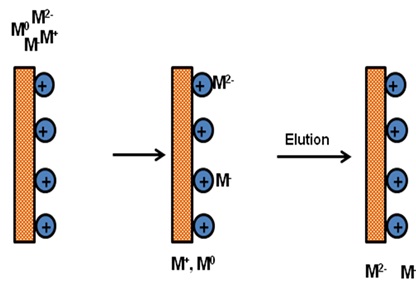
Figure 30.1: Affinity of analytes (M, M+, M-1, M-2) towards positively charged matrix.