Primer-template homology: Primers should be designed in such a way that there should be no homology within the template other than the target site. This will result in non specific binding and amplification.
Analysis of PCR results: Once PCR cycle is complete, the amplified product is loaded in the agarose gel and observed after ethidium bromide staining under UV light source (Figure 15.3). A water blank reaction is included to monitor the cross contaminating DNA source as template. The percentage of agarose gel depends on the size of DNA to be visualized. Generally 0.8-1% agarose gel is used for analyzing 0.5-5 kb amplified DNA while a DNA of larger size or genomic DNA is visualized in gel as low as 0.5%.
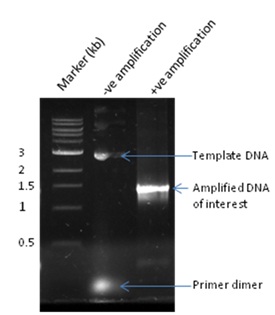 |
Figure 15.3: Analysis of PCR product on a agarose gel. |