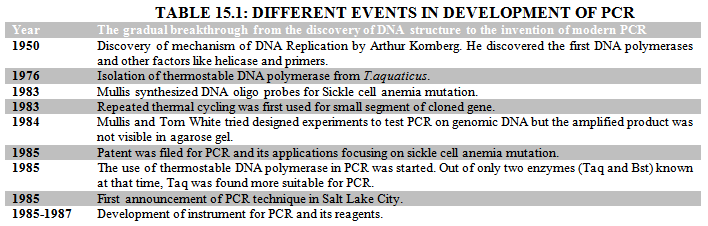
Introduction : Polymerase chain reaction (PCR) is used to amplify a DNA sequence to produce millions of copies. Kary Mullis discovered the PCR and got Nobel Prize in Chemistry in 1993 for his discovery. Since then, PCR has been used in various applications in medicine, animal science, plant science, food science etc. The different events to develop present day PCR is given in Table 15.1.
Principle of the technique: The whole process of PCR involves three main events, Denaturation, Annealing and Elongation (Figure 15.1). A DNA fragment of interest is used as a template and a pair of primers which are short oligonucleotides complimentary to the both strands of the template DNA. The purpose of primer is to initiate the DNA synthesis in the direction of 5' to 3'. The number of amplified DNA or the amplicons increases exponentially per cycle thus one molecule of DNA gives rise to 2,4,8,16 and so forth. This continuous doubling is carried out by a specific enzyme called DNA polymerase which sits at the unfinished double stranded DNA created by template DNA and primer. For further extension of the DNA, the polymerase enzyme require supply of other DNA-building blocks such as the nucleotides consisting of four bases Adenine (A), Thymine (T), Cytosine (C) and Guanine (G). The template, primer, polymerase and four bases are the main components for polymerase chain reaction.