1.3. Dissection room or sterilization room
This area should have restricted entry, which is needed to ensure the sterile conditions required for the transfer operations. For sterile transfer operations, the laminar-air-flow cabinets are used. Temperature control is essential in this room as the heat is produced continuously from the flames of burners in the hoods. The room should be constructed in a way to minimize the dust particles and for easy cleaning. Several precautions can be taken including the removal of shoes before entering the area.
The laminar horizontal flow sterile transfer cabinets are available in various sizes from many commercial sources. They should be designed with horizontal air flow from the back to the front, and equipped with gas cocks if gas burners are to be used. Electrical outlets are needed for use of electric sterilizers and microscopes, and if weighing is to be done in the hoods. A stainless steel working platform is most durable, easy to keep clean and to prevent the unwanted damage due to accidental fire. Sometimes it is fitted with Ultraviolet light to maintain sterility inside the cabinet. UV light is a source of ozone, which can be mutagenic, therefore, utmost care is to be taken while using this. Although UV light is not necessary, a short exposure time of 3-5 min to cabinet is fine sometimes. Work can be started after 10-15 min of switching on the air flow, and one can work uninterrupted for long hours.
A Laminar-air-flow cabinet has small motor to blow air which first passes through a coarse filter, where it loses large particles, and subsequently through a fine filter known as ‘high efficiency particulate air (HEPA). The HEPA filters remove particles larger than 0.3 µm, and the ultraclean air flows through the working area. The velocity of the ultra clean air is about 27 ± 3 m min-1 which is adequate for preventing the contamination of the working area as long as the flow is on. The flow of the air does not in any way hamper the use of a spirit lamp or a Bunsen burner. A
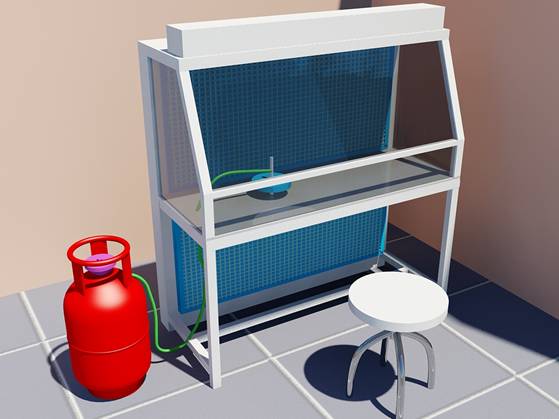
Figure 2.3: Laminar-air-hood with coarse filter, HEPA filter, gas cock, gas cylinder and electrical outlets