1. Laboratory Design and Development
The size of tissue culture lab and the amount and type of equipment used depend upon the nature of the work to be undertaken and the funds available. A standard tissue culture laboratory should provide facilities for:
• washing and storage of glassware, plasticware
• preparation, sterilization and storage of nutrient media
• aseptic manipulation of plant material
• maintenance of cultures under controlled temperature, light and humidity
• observation of cultures, data collection and photographic facility
• acclimatization of in vitro developed plants. The overall design must focus on maintaining aseptic conditions.
At least three separate rooms should be available one for washing up, storage and media preparation (the media preparation room); a second room, containing laminar-air-flow or clean air cabinets for dissection of plant tissues and subculturing (dissection room or sterilization room); and the third room to incubate cultures (culture room). This culture room should contain a culture observation table provided with binoculars or stereozoom microscope and an adequate light source. Additionally, a green house facility is required for hardening-off in vitro plantlets. For a commercial set-up, a more elaborate set-up is required. A suitable floor plan is shown in Figure 2.1.
1.1. Media preparation room
The washing area in the media room should be provided with brushes of various sizes and shapes, a large sink, preferably lead-lined to resist acids and alkalis, and running hot and cold water. It should also have large plastic buckets to soak the labware to be washed in detergent, hot-air oven to dry washed labware and a dust-proof cupboard to store them. If the preparation of the medium and washing of the labware are done in the same room, a temporary partition can be constructed between the two areas to guard any interference in the two activities. A continuous supply of water is essential for media preparation and washing of labware. A water distillation unit of around 2 litre/h, a Milli-Q water purification systems needs to be installed.
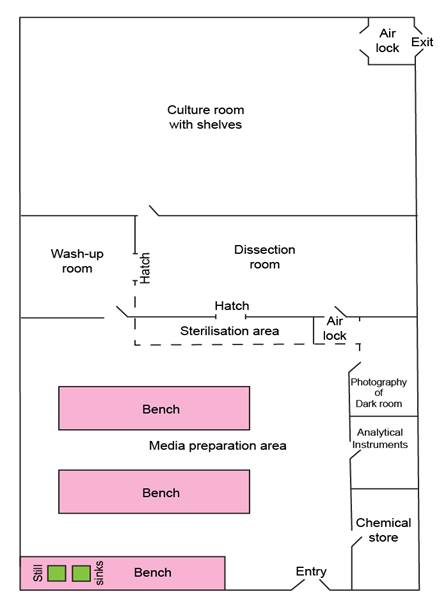
Figure 2.1: A floor plan for plant tissue culture laboratory