Chemiosmotic mechanism of ATP generation:
- • Mechanism of ATP synthesis using the electron transport chain is called chemiosmosis.
• Substances diffuse passively across membranes from areas of high concentration to areas of low concentration, this diffusion yields energy. In chemiosmosis, the energy released when a substance moves along a gradient is used to synthesize ATP.
1. As energetic electrons from NADH (or chlorophyll) pass down the electron transport chain, some of the carriers in the chain pump actively transport – protons across the membrane. Such carrier molecules are called proton pumps.
2. The phospholipid membrane is normally impermeable to protons, so this one-directional pumping establishes a proton gradient. The excess H+ on one side of the membrane makes that side positively charged compared with the other side. The resulting electrochemical gradient has potential energy, called the proton motive force.
3. The protons on one side of the membrane can diffuse across the membrane only through special protein channels that contain an enzyme called adenosine triphosphate (ATP synthase). When this flow occurs, energy is released and is used by the enzyme to synthesize ATP from ADP and Pi.
• Electron transport chain also operates in photophosphorylation and is located in the thylakoid membrane of cyanobacteria and eukaryotic chloroplasts.
Summary of Aerobic respiration:
- • Electron transport chain regenerates NAD+ and FAD+ which can be used again in glycolysis and Krebs cycle.
• Various electron transfers in the electron transport chain generates about 34 molecules of ATP from each molecule of glucose oxidized, 10 NADH and 2 FADH2 .
• A total of 38 ATP molecules can be generated from one molecule of glucose in prokaryotes.
• A total of 36 molecules of ATP are produced in eukaryotes. Some energy is lost when electrons are shuttled across the mitochondrial membranes that separate glycolysis (in the cytoplasm) from the electron transport chain. No such separation exists in prokaryotes.

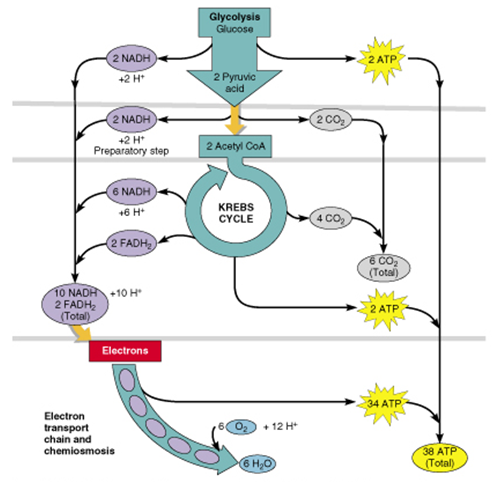
Fig. 6. Generation of ATPs and NADH/FADH2 during Aerobic Respiration
REFERENCES:
Text Books:
1. Jeffery C. Pommerville. Alcamo's Fundamentals of Microbiology (Tenth Edition). Jones and Bartlett Student edition.
2. Gerard J. Tortora, Berdell R. Funke, Christine L. Case. Pearson - Microbiology: An Introduction. Benjamin Cummings.
Reference Books:
1. Lansing M. Prescott, John P. Harley and Donald A. Klein. Microbiology. Mc Graw Hill companies.