Alternatives of Glycolysis:
Many bacteria have another pathway in addition to glycolysis for the oxidation of glucose. The most common are i) pentose phosphate pathway and ii) Entner-Doudoroff pathway
1. Pentose Phosphate pathway (Hexose monophosphate shunt): This provides a means for the breakdown of five-carbon sugars (pentoses) as well as glucose. A key feature is that it produces important intermediates pentoses used in the synthesis of nucleic acids, glucose from Co2 in photosynthesis and certain amino acids. The pathway is an important producer of the reduced coenzyme NADPH from NADP+. This pathway yields a net gain of only one molecule of ATP for each molecule of glucose oxidised. Bacteria that use this pathway include Bacillus subtilis, E.coli, Leuconostoc mesenteroides and Enterococcus faecalis.
The Entner-Doudoroff pathway: For each molecule of glucose this pathway produces 2 molecules of NADPH and one molecule of ATP for use in cellular biosynthetic reactions. Bacteria that have the enzymes for this pathway can metabolize glucose without either glcolysis or the pentose phosphate pathway. Found in some gram-negative bacteria, including Rhizobium , Pseudomonas and Agrobacterium ; generally not found among gram-positive bacteria.
Cellular/Aerobic respiration
After glucose has been broken down to pyruvic acid, the pyruvic acid can be channeled into the next step of either fermentation or cellular respiration.
Cellular respiration – is defined as an ATP generating process in which molecules are oxidized and the final electron acceptor is an inorganic molecule. Two types of respiration occur, depending on whether an organism is an aerobe or an anaerobe. In aerobic respiration – the final electron acceptor is O2 and in anaerobic respiration – it is an inorganic molecule other than O2 or rarely an organic molecule.
The Krebs cycle /Citric Acid Cycle/ Tricarboxylic Acid Cycle
The pyruvate produced by glycolysis is oxidized completely, generating additional ATP and NADH in the citric acid cycle and by oxidative phosphorylation. However, this can occur only in the presence of oxygen. Oxygen is toxic to organisms that are obligate anaerobes, and are not required by facultative anaerobic organisms. In the absence of oxygen, one of the fermentation pathways occurs in order to regenerate NAD+; lactic acid fermentation is one of these pathways.
In eukaryotic cells, the citric acid cycle occurs in the matrix of the mitochondrion . Bacteria also use the TCA cycle to generate energy, but since they lack mitochondria, the reaction sequence is performed in the cytosol with the proton gradient for ATP production being across the plasma membrane rather than the inner membrane of the mitochondrion.
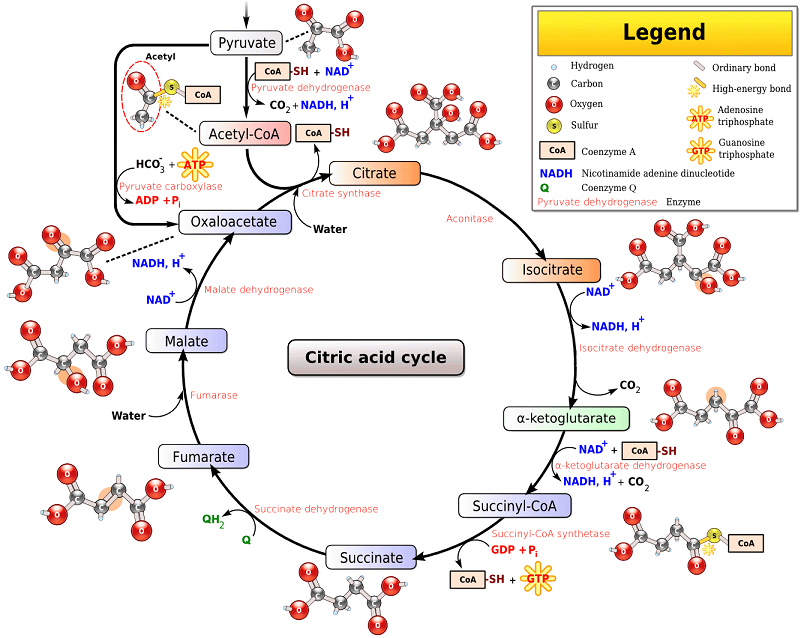
Fig. 4. Citric Acid cycle