The Electron Transport Chain:
- • Consists of a sequence of carrier molecules that are capable of oxidation and reduction.
• As electrons are passed through the chain, there is a stepwise release of energy, used to drive the chemiosmotic generation of ATP.
• In eukaryotic cells, it is contained in the inner membrane of mitochondria.
• In prokaryotes, it is found in the plasma membrane.
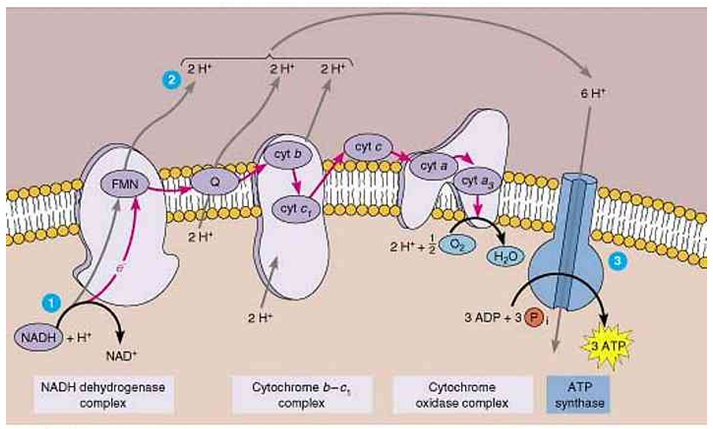
Fig. 5. Electron Transport Chain
Three classes of carrier molecules are involved:
1. Flavoproteins – these contain flavin, a coenzyme derived from riboflavin (Vitamin B2). One important flavin coenzyme is flavin mononucleotide (FMN).
2. Cytochromes – proteins with an iron-containing group capable of existing alternately as a reduced form (Fe2+) and an oxidized form (Fe3+). The cytochormes include cytochrome b, C1, a, a3.
3. Ubiquinones or Coenzyme Q – these are small non-protein carriers.
- • Electron transport chains of bacteria are somewhat diverse, and the particular carriers and the order in which they functions may differ from those of other bacteria and from those of eukaryotic mitochondrial systems. Much is known about the electron transport chain in the mitochondria of eukaryotic cells.
1. Transfer of high energy electrons from NADH to FMN, the first carrier in the chain. This transfer involves at the passage of a hydrogen atom with 2e- to FMN, which then pick up an additional H+ from the surrounding aqueous medium. NADH is oxidised to NAD+ and FMN reduced to FMNH2.
2. FMNH2 passes 2H+ to the other side of the mitochondrial membrane and passes 2e- to Q. As a result FMNH2 is oxidized to FMN. Q picks up an additional 2H+ from the medium and releases it on the other side of the membrane.
3. Electrons are passed successively from Q to Cyt b, cyt c1, cyt c, cyt a and cyt a3. Each cytochrome in the chain is reduced as it picks up e-and is oxidised as it gives up electrons. The last cyt a3 passes it electrons to molecular O2, which becomes negatively charged and then picks up protons from the medium to form H2O.
- • FADH2 adds its electrons to the electron transport chain at a lower level than NADH. Because of this, the electron transport chain produces about one-third less energy for ATP generation when FADH2 donates electrons than when NADH is involved.
• FMN and Q accept and release protons as well as electrons and other carrier cytochromes transfer only electrons.
• Electron flow down the chain is accompanied at several points by the active transport (Pumping) of protons from the matrix side of the inner mitochondrial membrane to the opposite side of the membrane. The result is build up of protons on one side of the membrane, which provides energy for the generation of ATP by the chemiosmotic mechanism.