4-4.2.3. Number of clones required for alibrary
The number of clones to be pooled depends upon the size of the genome f and average size of the cloned DNA.
Let ( f ) be the fraction of the genome size compared to the average individual cloned fragment size, would represent the lowest possible number of clones that the library must contain.
The minimum number of clones required can be calculated as-
f = genome size/ fragment size
For the E. coli genome (4.6 Mb)with an average cloned fragment size of 5 kb, f will be 920.
The number of independent recombinants required in the library must be greater than f, as sampling variation leads to the several times inclusion and exclusion of some sequences in a library of just f recombinants. In 1976, Clarke and Carbon derived a formula to calculate probability (P) of including any DNA sequence in a random library of N independent recombinants.
The actual number of clones required can be calculated as-
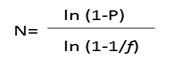
where N= number of clones and P= probability that a given gene will be present.
Bigger the library better will be the chance of finding the gene of interest. The pooling together of either recombinant plaques or bacterial colonies generates a primary library.