(b) Enzymatic method
• It involves use of restriction enzyme for the fragmentation of purified DNA.
• This method is limited by distribution probability of site prone to the action of restriction enzymes which will generate shorter DNA fragments than the desired size.
• If, a gene to be cloned contains multiple recognition sites for a particular restriction enzyme, the complete digestion will generate fragments that are generally too small to clone. As a consequence, the gene may not be represented within a library.
• To overcome this problem, partial digestion of the DNA molecule is usually carried out using known quantity of restriction enzyme to obtain fragments of ideal size.
• The two factors which govern the selection of the restriction enzymes are- type of ends (blunt or sticky) generated by the enzyme action and susceptibility of the enzyme to chemical modification of bases like methylation which can inhibit the enzyme activity.
• The fragments of desired size can be recovered by either agarose gel electrophoresis or sucrose gradient technique and ligated to suitable vectors.
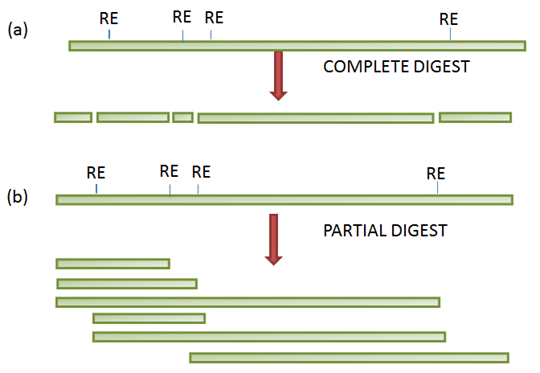
Figure 4-4.2.1: The complete (a) and partial (b) digestion of a DNA fragment using restriction enzymes.
(Adapted from Reece RJ. 2000. Analysis of Genes and Genomes. John Wiley & Sons, U.K.)