Leucopoiesis
Leucopoiesis is the process by which white blood cells or lymphocytes
(B-cells and T-cells) are produced and developed from the lymphoid progenitor cells, it is also known as leukocytopoiesis or lymphopoesis. Lymphocytes are formed in the six constituents of the lymphomyeloid complex (LMC) which are namely the bone marrow, thymus, lymph nodes, subepithelial lymphoid tissue, spleen, connective tissue (including blood). The existence of specific markers on the lymphocyte membrane (CD-antigens) has enabled the differentiation of lymphocytic subpopulations. The largest number of the lymphocytes in the peripheral blood belongs to the subpopulations of the mature T-cells. A considerable smaller number of the lymphocytes belong to mature B-cells. The precursors of T- and B-cells are of the least number. Lymphoblast is the earliest morphologically recognizable cell of the lymphocytic lineage. During the lymphocytopoiesis, three developing cell forms can be seen. This process mainly comprises the formation of functional antigen receptors of the T-cells in the thymus and the ability to form and secrete immunoglobulins by the B cells in the bone marrow. Leucopoesis also results in development of natural killer cells (NKC). The process starts with the primitive reticular cell, which on activation developsinto cytoplasmic basophilia and finally becomes a lymphoblast. A series of cell divisions
(6-8 cell divisions)
results reduction in the amount of cytoplasm leading to the development of small lymphocyte.
B-cell development
B cell development occurs through several stages, each stage representing a change in the genome content at the antibody. When the B cell fails in any step of the maturation process, it will die by a mechanism called apoptosis. B cell leucopoesis is dependent on the integration of extracellular stimuli by transcription factors that specify hematopoietic progenitors to differentiation into highly-specialized effector B-cells. The B cell factor-1 or Ebf1 is expressed in the early stages of the B cell lineage and in the stromal cells of the bone marrow. Ebf1 functions in a complex regulatory network with other transcription factors to establish the B cell program. B cell membrane receptors evolve and change throughout the B cell life span. Examples of such receptors are the TACI, BCMA and BAFF-R which are present on both immature B cells and mature B cells. CD20 is expressed on all stages of B cell development except the first and last; it is present from pre-B cells through memory cells, but not on either pre-pro-B cells or plasma cells. Figure 3 illustrates the stages of B-cell development.
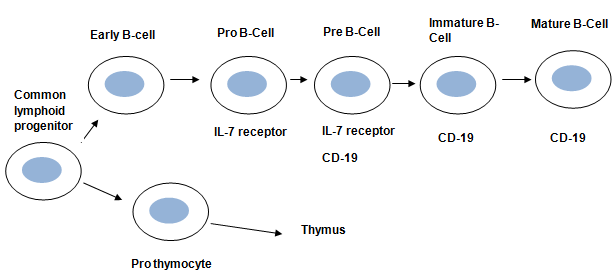
Figure 3: B cell developmental stages.
T-cell leucopoesis
T cells are formed in bone marrow and then they migrate to the cortex of the thymus to undergo maturation in an antigen-free environment for about one week. About 2-4% of the T cells succeed to mature and the other 96-98% of T cells undergoes apoptosis and is phagocytosed by macrophages in the thymus. This process is termed as thymus education wherein T-cells capable of recognizing self antigens undergo apoptosis.
The mature forms of T-cells are:
1. T-helper: Activatates of other cells such as B cells and macrophages.
2. T-cytotoxic: Kills virally infected cells.
3. T-memory: Remembers previously encountered antigens.
4. T-suppressor cells: Moderates the immune response of other leukocytes.
Interesting facts: (Lecture 1 and 2 )
1. Blood makes up around 7% of the weight of a human body which is about 5 liters.
2. Red blood cells develop in bone marrow and circulate in the body for around 120 days.
3. RBC lacks nucleus, mitochondria, Golgi apparatus and endoplasmic reticulum