Haemopoiesis
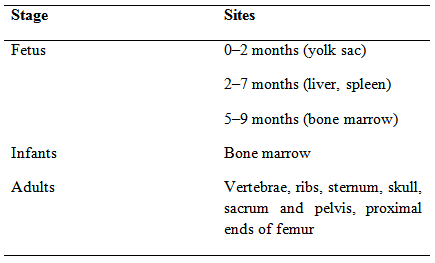
Haemopoiesis or haematopoiesis is the of process formation of new blood cellular components. It has been estimated that in an adult human, approximately 10 11 –10 12 new blood cells are produced daily in order to maintain steady state levels in the peripheral circulation. The mother cells from which the progeny daughter blood cells are generated are known as haematopoietic stem cells. In an embryo yolk sac is the main site of haemopoiesis whereas in human the basic sites where haemopoiesis occurs are the bone marrow (femur and tibia in infants; pelvis, cranium, vertebrae, and sternum of adults), liver, spleen and lymph nodes (Table 1). In other vertebrates haemapoiesis occurs in loose stroma of connective tissue of the gut, spleen, kidney or ovaries.
Table 1: Sites of Haemopoiesis in humans
The process of haemopoiesis
Pluripotent stem cells with the capability of self renewal, in the bone marrow known as the haemopoiesis mother cell give rise to the separate blood cell lineages. This haemopoietic stem cell is rare, perhaps 1 in every 20 million nucleated cells in bone marrow. Figure 1 illustrates the bone marrow pluripotent stem cell and the cell lines that arise from it. Cell differentiation occurs from a committed progenitor haemopoietic stem cell and one stem cell is capable of producing about 106 mature blood cells after 20 cell divisions. The process leads to division of stem cells and commitment of each cell to differentiate into one of the different blood progenitor cells. The cell lineage chosen by the progenitor cells is a matter both chance and on the external stimuli received by progenitor cells. Internal transcription factors like PU.1 commits cells to the myeloid lineage whereas GATA-1 leads to erythropoietic and megakaryocytic differentiation. The proliferation and differentiation of haemopoietic progenitor cells and the function of mature blood cells is in turn regulated by glycoprotein hormones like Granulocyte colony stimulating factor or G-CSF. The growth factors may cause cell proliferation but can also stimulate differentiation, maturation, prevent apoptosis and affect the function of mature cells. The other growth factors that act at various levels of haemopoiesis are interleukin (IL-1 and IL-3); macrophage colony-stimulating factor; stem cell factor; and tumour necrosis factor (Table 2).