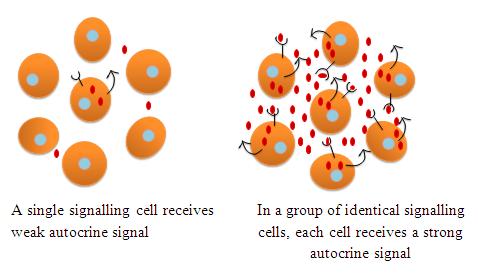
Figure 1 (b): Autocrine signaling A group of identical cells produces a higher concentration of a secreted signal than does a single cell.
2. Paracrine signaling:
In paracrine signaling (para = near), the signaling molecules released by a signal-releasing cell (secretory cell), affect only those target cells in close proximity as shown in Figure 2 (a) & (b). For paracrine signals to be delivered only to their proper targets, the secreted signaling molecules must not be allowed to diffuse too far; for this reason they are often rapidly taken up by neighboring target cells, destroyed by extracellular enzymes, or immobilized by the extracellular matrix. Many growth factors regulating development in multicellular organisms also act at a short range. Some of these molecules bind tightly to the extracellular matrix, unable to signal, but subsequently can be released in an active form. Many developmentally important signals diffuse away from the signaling cell, forming a concentration gradient and inducing different cellular responses depending on the distance of a particular target cell from the site of signal release. The conduction by a neurotransmitter of a signal from one nerve cell to another or from a nerve cell to a muscle cell occurs via paracrine signaling.
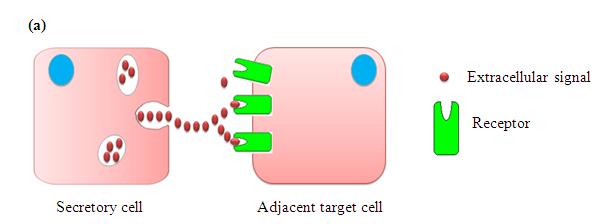
Figure 2 (a): Signaling molecules released by a secretory cell affect only the adjacent target cells.
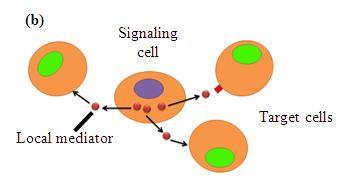
Figure 2 (b): Paracrine signaling: Signaling molecules released by a secretory cell affect only the adjacent target cells in close proximity