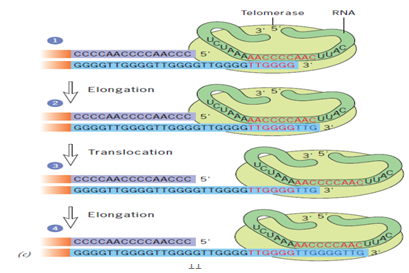
Figure 4: Telomerase replication. Telomerase contains an RNA primer that is complementary to the end of the G-rich strand, which extends past the C-rich strand. The telomerase RNA binds to the protruding end of the G-rich strand in step 1 and then serves as a template for the addition of nucleotides onto the 3’ terminus of the strand in step 2. After a segment of DNA is synthesized, the telomerase RNA slides to the new end of the strand being elongated in step 3 and serves as the template for the incorporation of additional nucleotides in step 4. The gap in the complementary strand is filled by the replication enzymes polymerase α-primase. This figure has been adapted from Cell and Molecular Biology Concepts and Experiments by Karp, 2010.
Telomerase activity is retained in germ cells and zygote and somatic cells after few cell division cycles do not show such activities because otherwise they would divide indefinitely and lead to cancer. Thus telomeres shrink causing chromosome shortening to a critical point when the cell ceases to grow and divide. An inherited disease called the Werner’s syndrome that causes patients to age much more rapidly than normal, is characterized by abnormal telomere maintenance.