This module deals with the genetic material of the cell, its structure, with details of the human chromosome and the giant chromosomes.
Genetic material in a cell: All cells have the capability to give rise to new cells and the encoded information in a living cell is passed from one generation to another. The information encoding material is the genetic or hereditary material of the cell.
Prokaryotic genetic material:
The prokaryotic (bacterial) genetic material is usually concentrated in a specific clear region of the cytoplasm called nucleiod. The bacterial chromosome is a single, circular, double stranded DNA molecule mostly attached to the plasma membrane at one point. It does not contain any histone protein. Escherichia coli DNA is circular molecule 4.6 million base pairs in length, containing 4288 annotated protein-coding genes (organized into 2584 operons), seven ribosomal RNA (rRNA) operons, and 86 transfer RNA (tRNA) genes. Certain bacteria like the Borrelia burgdorferi possess array of linear chromosome like eukaryotes.
Besides the chromosomal DNA many bacteria may also carry extra chromosomal genetic elements in the form of small, circular and closed DNA molecules, called plasmids. They generally remain floated in the cytoplasm and bear different genes based on which they have been studied. Some of the different types of plasmids are F plasmids, R plasmids, virulent plasmids, metabolic plasmids etc. Figure 1 depicts a bacterial chromosome and plasmid.
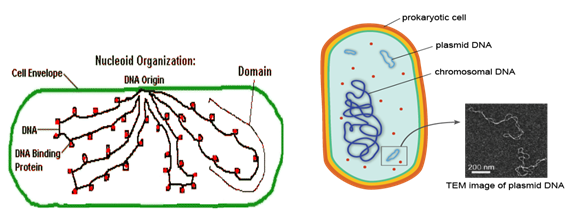
Figure 1: Bacterial genetic material
Virus genetic material:
The chromosomal material of viruses is DNA or RNA which adopts different structures. It is circular when packaged inside the virus particle.
Eukaryotic genetic material:
A Eukaryotic cell has genetic material in the form of genomic DNA enclosed within the nucleus. Genes or the hereditary units are located on the chromosomes which exist as chromatin network in the non dividing cell/interphase. This will be discussed in detail in the coming sections.
Chromosome:
German biologist Walter Flemming in the early 1880s revealed that during cell division the nuclear material organize themselves into visible thread like structures which were named as chromosomes which stains deep with basic dyes. The term chromosome was coined by W. Waldeyer in 1888. Chrome is coloured and soma is body, hence they mean “colored bodies” and can be defined as higher order organized arrangement of DNA and proteins. It contains many genes or the hereditary units, regulatory elements and other nucleotide sequences. Chromosomes also contain DNA-bound proteins, which serve in packaging the DNA and control its functions. Chromosomes vary both in number and structure among organisms (Table 1) and the number of chromosomes is characteristic of every species. Benden and Bovery in 1887 reported that the number of chromosomes in each species is constant. W.S. Sutton and T. Boveri in 1902 suggested that chromosomes are the physical structures which acted as messengers of heredity.