Chromosomes are tightly coiled DNA around basic histone proteins, which help in the tight packing of DNA. During interphase, the DNA is not tightly coiled into chromosomes, but exists as chromatin. The structure of a chromosome is given in Figure 2. In eukaryotes to fit the entire length of DNA in the nucleus it undergoes condensation and the degree to which DNA is condensed is expressed as its packing ratio which is the length of DNA divided by the length into which it is packaged into chromatin along with proteins.
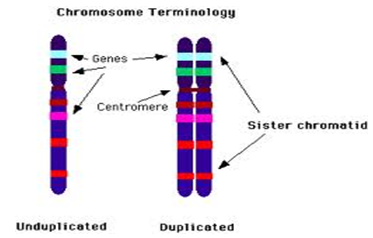
Figure 2: Eukaryotic chromosome
The shortest human chromosome contains 4.6 x 10⁷ bp of DNA. This is equivalent to 14,000 µm of extended DNA. In its most condensed state during mitosis, the chromosome is about 2 µm long. This gives a packing ratio of 7000 (14,000/2). The DNA is packaged stepwise into the higher order chromatin structure and this is known as “hierarchies of chromosomal organization”. The level of DNA packaging is schematically represented in Table 2.
Chromosome number:
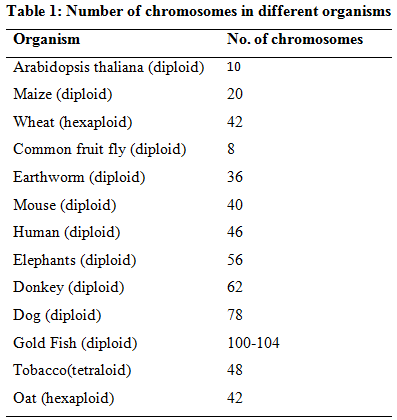
There are normally two copies of each chromosome present in every somatic cell. The number of unique chromosomes (N) in such a cell is known as its haploid number, and the total number of chromosomes (2N) is its diploid number. The suffix ‘ploid’ refers to chromosome ‘sets’. The haploid set of the chromosome is also known as the genome. Structurally, eukaryotes possess large linear chromosomes unlike prokaryotes which have circular chromosomes. In Eukaryotes other than the nucleus chromosomes are present in mitochondria and chloroplast too. The number of chromosomes in each somatic cell is same for all members of a given species. The organism with lowest number of chromosome is the nematode, Ascaris megalocephalusunivalens which has only two chromosomes in the somatic cells (2n=2).
Autosomes and sex chromosomes:
In a diploid cell, there are two of each kind of chromosome (termed homologus chromosomes) except the sex chromosomes. In humans one of the sex has two of the same kind of sex chromosomes and the other has one of each kind. In humans there are 23 pairs of homologous chromosomes (2n=46). The human female has 44 non sex chromosomes, termed autosomes and one pair of homomorphic sex chromosomes given the designation XX. The human male has 44 autosomes and one pair of heteromorphic sex chromosomes, one X and one Y chromosome.