Plant Vacuoles:
The most conspicuous compartment in most plant cells is a very large, fluid-filled vesicle called
a vacuole. There may be several vacuoles in a single cell, each separated from the cytoplasm by a single unit membrane, called the tonoplast. Generally vacuoles occupy more than 30 per cent of the cell volume; but this may vary from 5 per cent to 90 per cent, depending on the cell type. Plant cell vacuoles are widely diverse in form, size, content, and functional dynamics, and a single cell may contain more than one kind of vacuole. Most plant cells contain at least one membrane limited internal vacuole. The number and size of vacuoles depend on both the type of cell and its stage of development; a single vacuole may occupy as much as 80 percent of a mature plant cell. They are lytic compartments, function as reservoirs for ions and metabolites, including pigments, and are crucial to processes of detoxification and general cell homeostasis. They are involved in cellular responses to environmental and biotic factors that provoke stress. A variety of transport proteins in the vacuolar membrane allow plant cells to accumulate and store water, ions, and nutrients (sucrose, amino acids) within vacuoles. Like a lysosome, the lumen of a vacuole contains a battery of degradative enzymes and has an acidic pH, which is maintained by similar transport proteins in the vacuolar membrane. Plant vacuoles may also have a degradative function similar to that of lysosomes in animal cells. Similar storage vacuoles are found in green algae and many microorganisms such as fungi. Like most cellular membranes, the vacuolar membrane is permeable to water but is poorly permeable to the small molecules stored within it. Because the solute concentration is much higher in the vacuole lumen than in the cytosol or extracellular fluids, water tends to move by osmotic flow into vacuoles, just as it moves into cells placed in a hypotonic medium. This influx of water causes both the vacuole to expand and water to move into the cell, creating hydrostatic pressure, or turgor, inside the cell. This pressure is balanced by the mechanical resistance of the cellulose-containing cell walls that surround plant cells. Most plant cells have a turgor of 5–20 atmospheres (atm); their cell walls must be strong enough to react to this pressure in a controlled way. Unlike animal cells, plant cells can elongate extremely rapidly, at rates of 20–75 µm/h. This elongation, which usually accompanies plant growth, occurs when a segment of the somewhat elastic cell wall stretches under the pressure created by water taken into the vacuole.
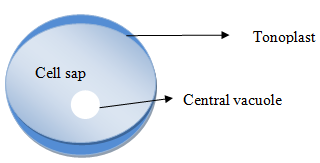
Figure 5: Plant cell central vacuole.
The central vacuole in plant cells (Figure 5) is bounded by a membrane termed the tonoplast which is an important constituent of the plant endomembrane system. This vacuole develops as the cell matures by fusion of smaller vacuoles derived from the endoplasmic reticulum and Golgi apparatus. Functionally it is highly selective in transporting materials through its membrane. The cell sap inside the vacuole differs from the cytoplasm.
Functions:
1. Vacuoles often store the pigments that give flowers their colors, which aid them in the attraction of bees and other pollinators.
2. It can also be comprised of plant wastes that while developing seed cells use the central vacuole as a repository for protein storage.
3. The central vacuole also is responsible for salts, minerals, nutrients, proteins and pigments storage which in turn helps in plant growth, and plays an important structural role for the plant.
4. Vacuoles are also important for maintaining turgor pressure which controls the rigidity of the cell. Due to the process of osmosis when a plant receives large amounts of water, the central vacuoles of the cell swell as the liquid enters within them, increasing turgor pressure, which helps maintain the structural integrity of the plant, along with the support from the cell wall. In the absence of enough water, however, central vacuoles shrink and turgor pressure is reduced, compromising the plant's rigidity and wilting takes place.
5. Plant vacuoles are also important for their role in molecular degradation and storage. Sometimes these functions are carried out by different vacuoles in the same cell, one serving as a compartment for breaking down materials (similar to the lysosomes found in animal cells), and another storing nutrients, waste products, or other substances. Several of the materials commonly stored in plant vacuoles have been found to be useful for humans, such as opium, rubber, and garlic flavoring, and are frequently harvested.
6. Sometimes Vacuoles contain molecules that are poisonous, odoriferous, or unpalatable to various insects and animals.