3. Thylakoids
The thylakoids (thylakoid = sac-like) consists of flattened and closed vesicles arranged as a membranous network. The outer surface of the thylakoid is in contact with the stroma, and its inner surface encloses an intrathylakoid space. Thylakoids get stacked forming grana. There may be 40 to 80 grana in the matrix of a chloroplast. The number of thylakoids per granum may vary from 1 to 50 or more. For example, there may be single thylakoid (red alga), paired thylakoids (Chrysophyta), triple thylakoids and multiple thylakoids (green algae and higher plants).
Like the mitochondria, the chloroplasts have their own DNA, RNAs and protein synthetic machinery and are semiautonomous in nature. Chloroplasts are the largest and the most prominent organelles in the cells of plants and green algae. Chloroplasts and mitochondria have other features in common: both often migrate from place to place within cells, and they contain their own DNA, which encodes some of the key organellar proteins. Though most of the proteins in each organelle are encoded by nuclear DNA and are synthesized in the cytosol, the proteins encoded by mitochondrial or chloroplast DNA is synthesized on ribosomes within the organelles.
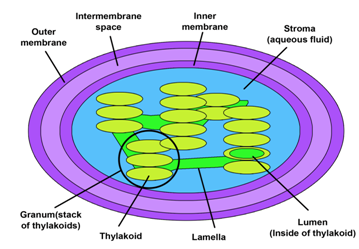
Figure 3: Structure of chloroplast.
Chloroplasts have a highly permeable outer membrane; a much less permeable inner membrane, in which membrane transport proteins are embedded; and a narrow intermembrane space in between. Together, these membranes form the chloroplast envelope (Figure 3). The inner membrane surrounds a large space called the stroma, and contains many metabolic enzymes.
The electron-transport chains, photosynthetic light-capturing systems, and ATP synthase are all contained in the thylakoid membrane, a third distinct membrane that forms a set of flattened disclike sacs, the thylakoids (Figure 4). The lumen of each thylakoid is connected with the lumen of other thylakoids, defining a third internal compartment called the thylakoid space, which is separated by the thylakoid membrane from the stroma that surrounds it.
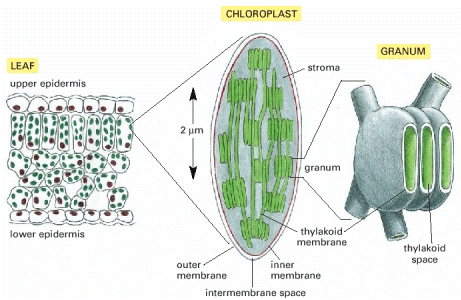
Figure 4. The structure of chloroplast and thylakoid. The figure has been printed with permission from Molecular Biology of the Cell. 4th edition. Alberts B, Johnson A, Lewis J, et al. New York: Garland Science; 2002.