Other than phosphorylation/dephosphorylation, protein degradation also controls cell cycle progression. During the metaphase to anaphase transition the key regulator which is the anaphase promoting complex (APC) catalyses ubiquitinylation and proteosomal destruction of S and M cyclins. Destroying these cyclins inactivates most Cdks in the cell. Another ubiquitin ligase called SCF ubiquitinylates certain CKIs in late G1phase controlling activation of S-Cdks and thus DNA replication. APC activity is in turn regulated by subunits which are Cdc20 during anaphase or Cdh1 during early G. An overview of cell cycle control system is illustrated in Figure 3.
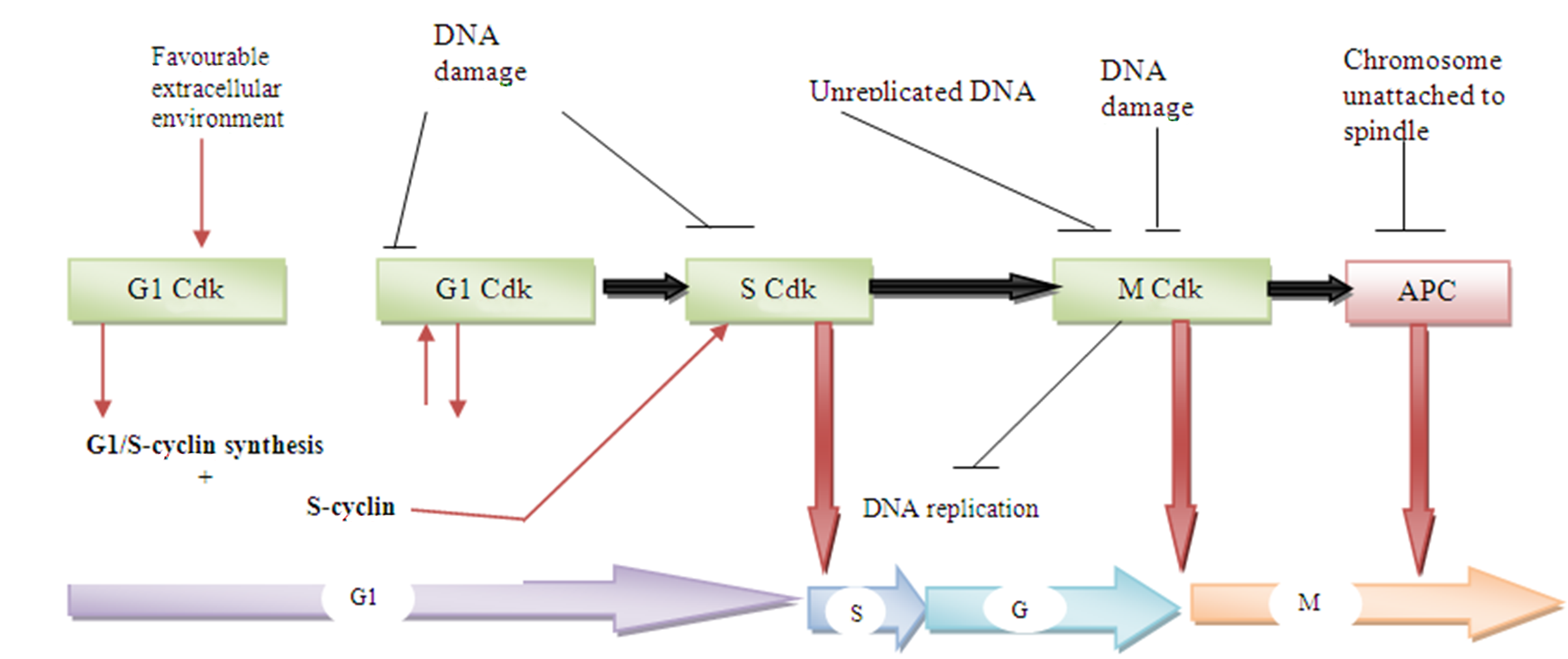
Figure 3 : An overview of the cell cycle control system. Activation of G1-Cdk is stimulated through various external and internal signals. This in turn activates genes encoding G1/S and S cyclins. G1/S Cdk results in wave of S-Cdk activity which initiates chromosome replication in S-phase and contributes to some early events in mitosis. M-Cdk activity then triggers progression through G2/M checkpoint. APC with its activator Cdc20 triggers metaphase to anaphase transition. Further multiple mechanisms suppress Cdk activity after mitosis resulting in stable G1 period. This figure has been adapted from “Molecular Biology of the Cell” by Alberts B et al., 2008 Vth edition, Garland Science, USA.