Cell cycle regulatory elements
Cyclin dependent kinases (Cdks) are the central components that coordinate activities throughout the cell cycle whose activities in turn are regulated by cyclin binding. The cyclin-Cdk complex causes phosphorylation of proteins that control chromosome condensation, nuclear envelope breakdown and other events that occur at the onset of mitosis. Cyclins can be divided into four classes.
1. G1/S cyclin: They activate Cdks in late G1 and their level fall in S phase.
2. S cyclin: They stimulate DNA replication and their level remains high until mitosis.
3. M cyclin: Activate Cdks that stimulate entry into mitosis at the G2/M checkpoint.
4. G1 cyclins: Governs the activities of G1/S cyclins.
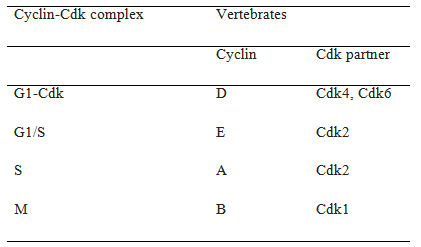
The cyclin protein not only activates Cdks but directs them to specific target proteins phosphorylating a different set of proteins. The different cyclin and Cdks of vertebrates has been presented in Table 1.
Table 1: The major cyclins and Cdks
Full activation of cyclin-Cdk complex occurs when Cdk-activating kinase phosphorylates an amino acid residue near the active site of Cdks. Furthermore Cdk activity peaks and falls during cell cycle and this process is controlled by Cdk-Inhibitory proteins (CKI) like p27 which inactivates cyclin A-Cdk2 complex. The structural basis of Cdk activation is illustrated in Figure 2. In inactive state without bound cyclin the active site is blocked by a protein region known as the T-loop. Cyclin binding causes T-loop to move out and its phosphorylation by CAK.
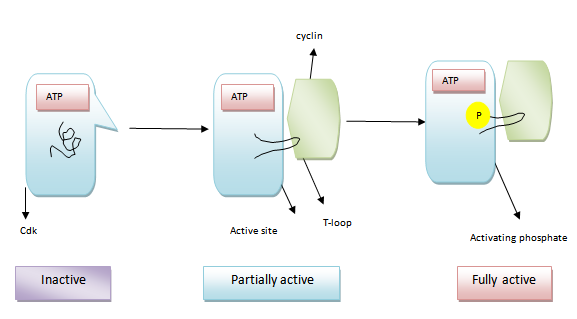
Figure 2: The structural basis of Cdk activation.