After studying mitosis and meiosis it is important to know how are cell cycles regulated. The present chapter talks about the cell cycle regulatory methods.
Cell cycle regulation:
Cell cycle is a highly regulated and coordinated process mediated by extracellular signals from the environment, as well as by internal signals. In most cells, this coordination between different phases of the cell cycle is dependent on a series of cell cycle checkpoints that prevent entry into the next phase of the cell cycle until the events of the preceding phase have been completed. The major cell cycle regulatory check point occurs late in G1 and controls progression from G1 to S. Other check points function to ensure complete genome transmittance to daughter cells. DNA damage checkpoints in G1, S, and G2 lead to cell cycle arrest in response to damaged or unreplicated DNA. Another checkpoint, called the spindle assembly checkpoint, arrests mitosis if the chromosomes are not properly aligned on the mitotic spindle ( Figure 1 ).
To restrict DNA replication once per cell cycle the G2 checkpoint ensures that the genome is replicated only once per cell cycle and that incompletely replicated DNA is not distributed to daughter cells. The molecular mechanism underlying this involves the action of the MCM (minichromosome maintenance complex) helicase that bind to replication origins together with the origin recognition complex (ORC) proteins. The MCM proteins are allowed to bind to replication origins during G1, leading to DNA replication when the cell enters S phase. After initiation the MCM proteins are dissociated from the origin, so replication cannot initiate again until next cell cycle. The association of MCM proteins with DNA during the S, G2 and M phases of the cell cycle is blocked by activity of the protein kinases that regulate cell cycle progression.
The cell cycle itself is under genetic control and the mechanisms of control are identical in all eukaryotes. There are two critical transitions: from G1 into S and from G2 into M. The G1/S and G2/M transitions are called "checkpoints" because the transitions are delayed unless key processes have been completed. For example, at the G1/S checkpoint, either sufficient time must have elapsed since the preceding mitosis or the cells have attained sufficient size for DNA replication to be initiated. Similarly, the G2/M checkpoint requires that DNA replication and repair of any DNA damage be completed for the M phase to commence.
Both control points are regulated in a similar fashion and use a specialized protein kinase called the p34 kinase subunit that regulates the activity of target proteins by phosphorylation and regulates cellular processes also. To become activated, this p34 polypeptide subunit combines with several other polypeptide chains called cyclins . At the G1/S control point, one set of cyclins combines with the p34 subunit to yield the active kinase which triggers DNA replication and other events of the S period. Similarly, at the G2/M control point, a second set of cyclins combines with the p34 subunit to yield the active kinase which initiates condensation of the chromosomes, breakdown of the nuclear envelope, and reorganization of the cytoskeleton in preparation for cytokinesis.
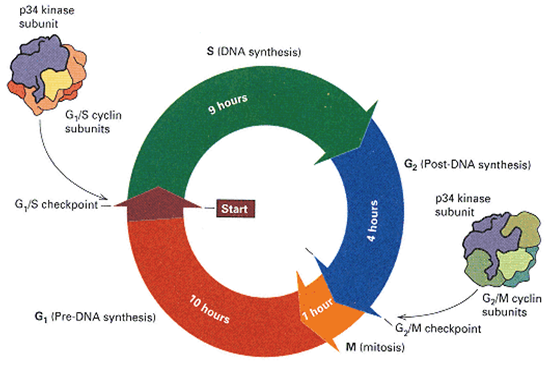
Figure 1: The cell cycle of a typical mammalian cell growing in tissue culture with a generation time of 24 hours. The critical control points for the G1S and G2M transitions are governed by a p34 kinase that is activated by stage-specific cyclins and that regulates the activity of its target proteins through phosphorylation.