Free Piston Shock Tunnel: In a typical shock tunnel, the high pressure in the driver section is achieved by filling the tube from a high pressure gas cylinder. Thus, the driver gas is normally at room temperature. In the low density environment, it is likely that condensation may arise in the test section. So, many test facilities involve preheating the driver gas. One of them is to use a free piston driver to operate the shock tunnel (Fig. 8.2.4). Here, the compression tube is filled with a driver gas (typically at atmospheric pressure) and is coupled to the driven section of low pressure region at one end and to a reservoir at very high pressure air (~100 bar). In this way, the piston separates the reservoir from the compression tube. When the piston is released for firing, it accelerates in the compression tube by acquiring the energy of expanding reservoir gas. The piston then approaches down to the compression tube and transfers all its energy to the driver gas. In this way, both temperature and pressure can be increased due to adiabatic compression mechanism. In a typical facility, the pressure up 900 bar and temperature of 4500K can be achieved. At this high pressure the primary diaphragm ruptures and shock tube flow is initiated in the similar manner as discussed earlier. In a well designed free piston shock tunnel, it is possible to achieve test flow duration up to 2ms.
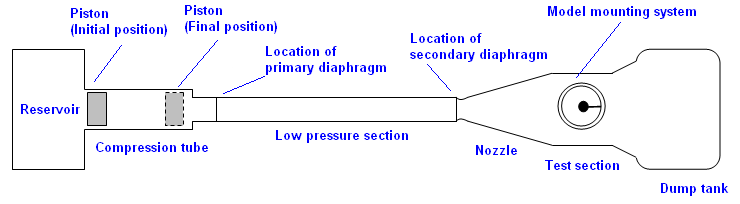
Fig. 8.2.4: Schematic diagram of a free piston shock tunnel.