Continuous wind Tunnel (Closed circuit type)
The major disadvantage of an open circuit wind tunnel is the test flow duration available for the model. However, if the Mach number/velocity requirement is not too high, than continuous operation of the blow down tunnel can be done by re-circulating the air. So, the schematic representation of Fig. 8.2.1 is modified through a return passage for air circulation. One more additional drier unit is also desired in the return passage to avoid condensation of re-circulating air in the test section of the tunnel (Fig. 8.2.2). In addition to the advantages of longer run times, this tunnel also provides good flow quality in the test section and the noise level is also less. However, the high construction cost is the major disadvantage of this tunnel.
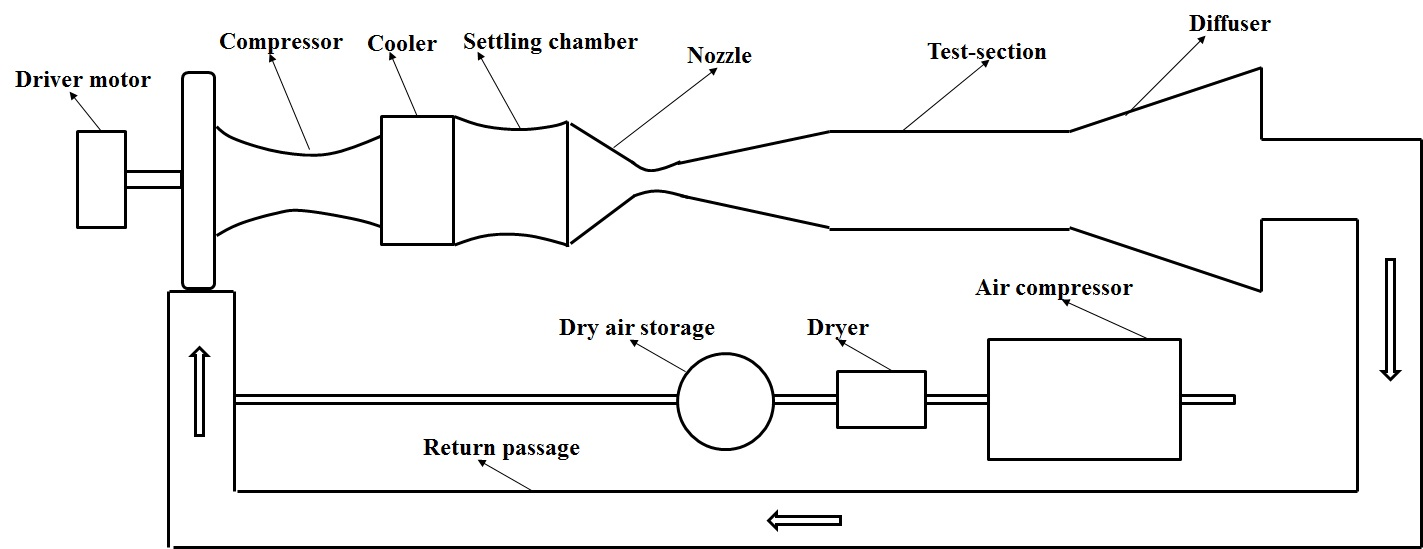
Fig. 8.2.2: Schematic diagram of a blow down wind tunnel (closed circuit).
Impulse-Type Tunnels
The conventional hypersonic wind tunnels face the challenges of simulating re-entry flight phenomena, long range ballistic missile test conditions that occurs at very altitudes. Since, the temperature can rise up to 10000K, there will be dissociations, chemical reactions as well. Hence, such investigations need real gas simulation conditions and it is almost impossible to achieve them in conventional hypersonic wind tunnels. So, the concept of impulse type aerodynamic facilities is introduced where it is desired to produce low density and high enthalpy flows for a very short duration (~ few milliseconds).
Expansion and shock tunnels are the typical aerodynamic testing facilities with a specific interest in high speeds and high temperature testing. Shock tunnels use steady flow nozzle expansion whereas expansion tunnels use unsteady expansion with higher enthalpy/thermal energy. In both cases the gases are compressed and heated until the gases are released, expanding rapidly down the expansion chamber. The tunnels reach speeds from Mach numbers ranging 3 to 30, thus creating testing conditions similar to that of very high altitudes.